

You see an ad: “ChatGPT Alternative – 10x Faster, $9.99/month”
Seems legit. Better than ChatGPT ($20/month). So you sign up.
This is what happens next:
- You enter credit card
- It charges you $9.99/month
- The tool barely works
- You try to cancel
- It keeps charging you
- Customer service doesn’t respond
- You’ve lost $50-100
This exact scam is running right now. Thousands of people falling for it monthly.
Here’s the scary part: AI’s explosive growth created a perfect scam environment.
Why?
- People don’t understand AI (easy to lie)
- Everyone wants cheap alternatives to ChatGPT
- Scammers move fast (before they’re caught)
- Victims often don’t report (embarrassed)
- Enforcement is slow (hard to prosecute globally)
By 2026, AI scams are a $2-5 billion industry.
Not hypothetical. Happening now.
This guide identifies:
- The 7 most common AI scams happening right now
- How to spot each one (red flags)
- Real examples (and what to do if you’re a victim)
- Protection strategies that actually work
- Tools to verify legitimacy
TABLE OF CONTENTS
1. The AI Scam Landscape
2. Scam 1: Fake AI Tool Clones
3. Scam 2: “Free” AI Promises (That Aren’t)
4. Scam 3: AI Cryptocurrency & Token Scams
5. Scam 4: Fake AI Courses & “Get Rich” Schemes
6. Scam 5: Job Interview AI Cheating Tools
7. Scam 6: Email/Chat AI Impersonation
8. Scam 7: Deepfake & Impersonation Scams
9. How to Verify Legitimate AI Tools
10. If You’ve Been Scammed (Recovery Guide)
1. THE AI SCAM LANDSCAPE
The Opportunity
When something becomes popular, scammers follow.
Internet (1990s) → Scams proliferate Social media (2010s) → Scam ecosystem grows AI (2020s) → Massive scam wave
Why AI is perfect for scams:
Reason 1: People Don’t Understand It
If someone tells you “This AI is powered by quantum computing,” you might believe it.
Most people can’t evaluate AI claims. They don’t know:
- What makes AI good or bad
- How much it should cost
- What it can actually do
Scammers exploit this knowledge gap.
Reason 2: High Demand, Limited Supply
Everyone wants to use AI, but:
- ChatGPT sometimes offline
- API access expensive
- Quality alternatives rare
Perfect gap for fake tools to fill.
Reason 3: Rapid Change = Confusion
AI changing every month.
New tools launching constantly. Hard to keep up.
Scammers use confusion as cover.
Reason 4: Global & Hard to Police
Scammer in Romania, victims in USA, PayPal in Luxembourg.
Jurisdiction nightmare for law enforcement.
Scammers know they likely won’t get caught.
2. SCAM 1: FAKE AI TOOL CLONES}
What It Is
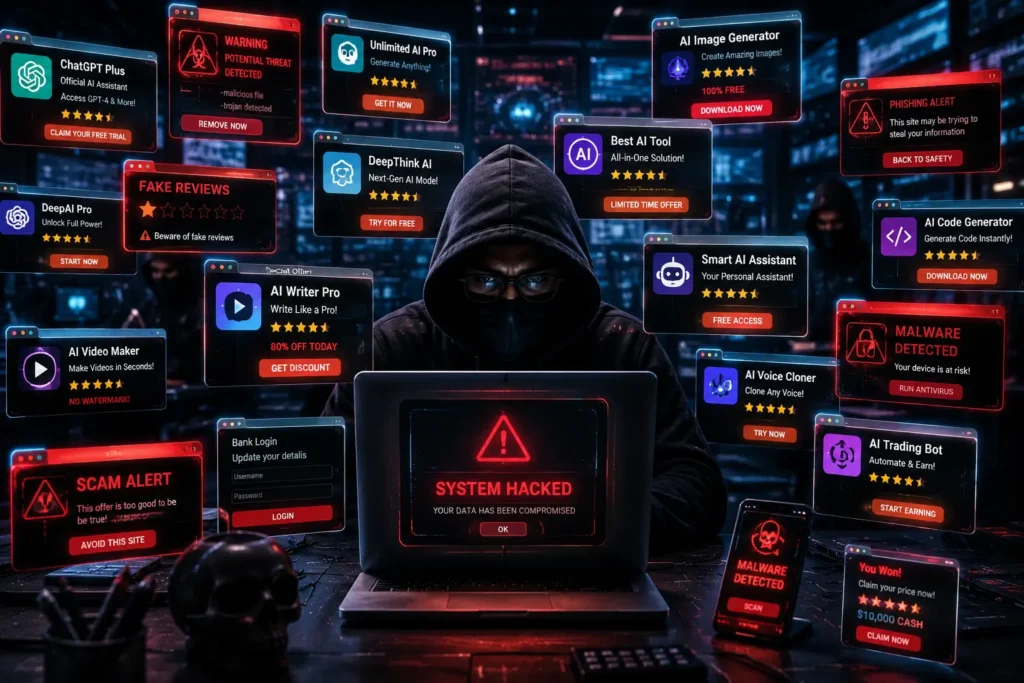
Fake website that looks like real AI tool (ChatGPT, Claude, etc.)
You think you’re using the real thing. You’re actually using a clone that:
- Steals your data
- Charges your card repeatedly
- Harvests credentials
- Sells your information
How It Works
Step 1: Create Fake Website
Scammer creates website that looks 99% like ChatGPT:
- Same logo (stolen)
- Same interface (copied)
- Similar URL (chatgpt-pro.com instead of openai.com)
- Same features (copied screenshots)
Step 2: Promote It
Run ads on Google/Facebook:
- “ChatGPT Alternative – Faster & Cheaper”
- “ChatGPT Pro Free Trial”
- “Unlimited ChatGPT – $5/month”
Target people who:
- Don’t want to pay for ChatGPT
- Want “unlimited” access
- Saw legitimate tool, looking for cheaper option
Step 3: Collect Data
When you sign up:
- You enter email
- You enter password
- You enter credit card
- You might answer security questions
Scammer now has all of this.
Step 4: Monetize
Option A: Charge your card monthly ($9.99, $14.99, etc.)
- You think it’s working
- You don’t check charges closely
- You lose $10-50/month indefinitely
Option B: Sell your data
- Email sold to spammers ($0.10 per email)
- Password used to hack your real accounts
- Credit card info sold on dark web
Option C: Use credentials to access real tools
- They use your account to use real ChatGPT
- They generate thousands of dollars of API calls
- Your credit card gets charged
Typical victim loss: $50-500 (before noticing)
Red Flags
🚩 URL is slightly different (chatgpt-pro instead of openai.com) 🚩 Promises unlimited access (real tools have limits) 🚩 Price is suspiciously cheap (<$10/month for ChatGPT alternative) 🚩 No company information (no “About Us,” fake contact info) 🚩 Unsolicited ad (legitimate tools don’t need aggressive ads) 🚩 Poor grammar/spelling on website 🚩 No payment security info (no SSL certificate, no payment processor details)
Real Example
Website: “chatgpt-free-pro.com” Offer: “ChatGPT Pro – Only $4.99/month” Reality: Fake clone that charged victims $4.99/month for 6+ months Victims: 8,000+ reported to FTC Total loss: ~$400,000 Status: Site taken down January 2024, operator still at large
3. SCAM 2: “FREE” AI PROMISES (THAT AREN’T)
What It Is
“Free AI tool” that requires payment for actual use.
Bait-and-switch: Claims free, delivers paywall.
How It Works
Step 1: Attract with “Free”
- “Free ChatGPT Alternative”
- “Unlimited AI Writing – Completely Free”
- “AI Image Generator – Zero Cost”
People click because… it’s free!
Step 2: Get You Invested
You sign up, use for free:
- Generate 10 images (free)
- Write 5 documents (free)
- Create 3 videos (free)
Works great. You get comfortable using it.
You tell friends: “This is amazing and it’s free!”
Step 3: Hit Paywall
“You’ve used your free allocation. Upgrade to premium for unlimited.”
Options:
- $9.99/month (entry tier)
- $29.99/month (professional)
- $99.99/month (unlimited)
Step 4: Recurring Charge
You subscribe to $9.99/month.
Then:
- Charges keep renewing
- No easy way to cancel
- Customer support unresponsive
- They “lose” your cancellation request
Typical victim loss: $50-200/month
The Twist: Feature Downgrade
After you pay, they might:
- Reduce quality
- Add watermarks
- Slow down service
- Change terms
You’re locked in (takes effort to cancel), so many just accept it.
Red Flags
🚩 “Completely free” but requires credit card (true free tools don’t need this) 🚩 Vague pricing (no clear breakdown) 🚩 Hard-to-find cancel button (buried in settings) 🚩 “Unlimited” but soft limits (technically unlimited but throttled) 🚩 Aggressive upsell (constant “Upgrade now” popups) 🚩 No contact info or fake customer support 🚩 Auto-renewing subscription without clear confirmation
Real Example
Tool: “ImageAI Free” Offer: “Generate unlimited AI images – completely free” Reality: Free tier = 5 images, then paywall at $14.99/month Problem: Users reported charges continued after cancellation Victims: 50,000+ charged inappropriately Settlement: Company forced to refund $2 million
4. SCAM 3: AI CRYPTOCURRENCY & TOKEN SCAMS
What It Is
Fake “AI cryptocurrency” or “AI token” promising massive returns.
“Invest $1,000, get 10,000 tokens, each worth $1 by next year!”
Reality: Worthless token, your money gone forever.
How It Works
Step 1: Create Hype
Launch website claiming:
- “Revolutionary AI-powered cryptocurrency”
- “AI automatically trades stocks”
- “Guaranteed 100% monthly returns”
- “Limited tokens available – buy now”
Use marketing:
- Fake testimonials (“Investor made $50,000!”)
- Fake team members (photos stolen from LinkedIn)
- Fake partnerships (“Endorsed by OpenAI” – they never endorsed anything)
- Discord/Telegram community (full of fake accounts)
Step 2: Create Urgency
“Only 1,000 tokens remaining!” “Price increases in 24 hours!” “Limited opportunity!”
People panic-buy without thinking.
Step 3: Collect Money
You buy 10,000 tokens for $1,000.
Your money goes to scammer’s wallet.
Token in your wallet appears valuable on website:
- $0.10/token = $1,000 value on fake exchange
Looks legit. You think you’re rich.
Step 4: The Exit
When you try to sell:
- Exchange is offline
- “Maintenance” (indefinitely)
- Withdrawal fee is 50% of value
- Or token simply disappears
Your $1,000 is gone.
Why People Fall For It
Cryptocurrency is confusing. Blockchain is mysterious.
AI + blockchain = ultra-confusing = easy to scam.
People don’t realize:
- Token has no real value
- Website fake exchange doesn’t matter
- Real exchanges don’t list fake coins
- “Guaranteed returns” are impossible
Red Flags
🚩 Guaranteed returns (crypto has no guarantees) 🚩 AI that “automatically trades” (doesn’t exist) 🚩 Vague team information (stolen photos, no LinkedIn profiles) 🚩 Limited tokens with increasing price (classic scam) 🚩 Private Discord community only (no public information) 🚩 Testimonials but no verifiable people (can’t find them online) 🚩 Pressure to buy now (urgency = red flag)
Real Example
Token: “AIBoost Coin” Offer: “AI-powered trading, 50% monthly returns” Raised: $5 million from 20,000+ investors Reality: Fake token, no real product, team disappeared Status: Investigated by SEC, operators charged Victims Lost: $5 million
5. SCAM 4: FAKE AI COURSES & “GET RICH” SCHEMES
What It Is
Course promising “Learn AI, Make $10,000/month” or “AI Secrets Revealed”
Usually $200-1,000 course that teaches nothing useful.
How It Works
Step 1: Create Urgency
“Enroll by Friday – Price increases Monday” “Only 50 spots available” “Last cohort before price increase”
Step 2: Make Big Promises
“Learn AI secrets that big companies don’t want you to know” “Make $5,000-$10,000/month from home” “No experience required” “Step-by-step system guaranteed to work”
Step 3: Sell with Fake Proof
“I made $50,000 in my first month!” “Student earned $15,000 using my system!” “See my bank statement proof!” (faked/edited)
YouTube videos of people showing “earnings” (faked).
Fake testimonials (AI-generated faces).
Step 4: Deliver Low-Value Content
You enroll and get access to:
- Pre-recorded videos (poor quality)
- Copy-pasted articles from free sources
- Generic “AI tools” everyone already knows
- No actual system (just “use ChatGPT to write”)
- No support (Discord channel with bot responses)
Step 5: No Refund
You realize it’s garbage.
Try to get refund.
“No refunds on digital products. You can request one within 30 days” (but approval is denied).
Or course uses payment processor with weak refund policies.
Your $500 is gone.
The Real Cost
Not just money lost, but:
- Time wasted
- False hope
- Trust damaged
People then think “AI education is a scam” (when it’s just that course).
Red Flags
🚩 Guaranteed income claims (“Make $10k/month”) 🚩 “Secrets” the company doesn’t want you to know (no company is hiding ChatGPT from you) 🚩 Fake testimonials (can’t verify real people) 🚩 Urgency pricing (“Offer ends Friday!”) 🚩 No sample content before you buy 🚩 Poor refund policy (“No refunds on digital products”) 🚩 Vague curriculum (“Module 1: AI Secrets”, no detail)
Real Example
Course: “AI Millionaire Blueprint” Price: $997 Offer: “Make $50,000-$100,000 from AI” Content: Generic ChatGPT tutorials Complaints: 500+ 1-star reviews Action: FTC sued course creator for false advertising Settlement: $2 million refund ordered
6. SCAM 5: JOB INTERVIEW AI CHEATING TOOLS
What It Is
Tool claiming to help you “ace job interviews” using AI.
Usually:
- Costs $50-200
- Promises to give you answers during interview
- Gets you disqualified (and banned from company)
How It Works
Tool sells to desperate job seekers:
- “AI will whisper answers in your ear”
- “Use AI to pass any interview”
- “Guaranteed job offer”
Reality:
- Tool doesn’t work (AI can’t whisper, companies use video call)
- If it did work, you’d be using unauthorized help (cheating)
- Company finds out, you’re banned from hiring
Why People Buy
Desperation. Job search is hard.
Promise of “easy win” appeals to people struggling.
They don’t think through consequences.
Real Consequences
If caught:
- Job offer rescinded
- Blacklisted from company
- Reference damaged
- Resume credibility hurt
One “easy win” ruins your career.
Red Flags
🚩 “Guaranteed job” (no tool can guarantee jobs) 🚩 “AI will help during interview” (companies monitor interviews) 🚩 Expensive for vague claims ($200 tool with no clear method) 🚩 Testimonials from “unemployed to hired” (easily faked) 🚩 No sample content 🚩 Pressure to buy now (before “filling spots”)
7. SCAM 6: EMAIL/CHAT AI IMPERSONATION

What It Is
Scammer impersonates you or someone you know.
Uses AI to:
- Write convincing emails
- Generate realistic text
- Impersonate your voice (coming soon)
How It Works
Scenario: Impersonate CEO
Scammer:
- Finds company org chart
- Picks CEO
- Uses AI to write email in CEO’s style
- Sends to accounting department: “Wire $100,000 to [scammer account]. Urgent deal. Confidential.”
Email looks real. CEO’s tone is right. Grammar is perfect.
Accounting department wires money.
By the time it’s caught, money’s gone.
Scenario: Impersonate You
Scammer gets access to your email (password breach, phishing).
Uses AI to:
- Write emails in your style
- Email your contacts: “I’m stuck overseas. Need $5,000 wire transfer urgently.”
- Looks like it came from you
Friends send money thinking it’s you.
Why AI Makes This Worse
AI can:
- Learn someone’s writing style from a few emails
- Generate realistic text in seconds
- Match tone, vocabulary, signature perfectly
- Bypass human skepticism (“it even sounds like them”)
8. SCAM 7: DEEPFAKE & IMPERSONATION SCAMS
What It Is
AI-generated fake video/audio of someone impersonating them.
Early versions crude. Future versions indistinguishable from real.
How It Works
Example: Deepfake CEO Video
Scammer creates video of CEO saying: “Hi team, we’re being acquired. Send all your stock options details to this email.”
Video looks real. Audio sounds real. Deepfake technology good enough to fool people.
Employees comply. Information stolen.
Status in 2026: Technology improving. Becoming harder to detect.
Real-World Impact
Already happening:
- Deepfake used in financial fraud
- Deepfake used in romance scams
- Deepfake used in extortion
By 2026: Deepfakes will be sophisticated enough to fool most people.
9. HOW TO VERIFY LEGITIMATE AI TOOLS
The Verification Checklist
Check 1: Official Website
🔍 Go directly to official site, don’t click ads
Type in URL yourself:
- openai.com (ChatGPT official)
- anthropic.com (Claude official)
- google.com/bard (Gemini official)
Don’t use links from:
- Random ads
- Random websites
- Random emails
Check 2: Company Information
✓ Real company has:
- Real office address
- Real phone number (that works)
- Real support email (that responds)
- LinkedIn profiles of team members
- News articles about the company
- Verified social media accounts
❌ Fake company lacks:
- Real address (or uses UPS box)
- Phone number (doesn’t answer)
- Support (unresponsive)
- Team members you can verify
- Press coverage
- Fake social accounts
Check 3: Payment Security
✓ Secure payment:
- HTTPS (lock icon in URL bar)
- Clear payment processor (Stripe, Square, major company)
- SSL certificate (green padlock)
- Clear refund policy
- Terms and conditions visible
❌ Suspicious payment:
- HTTP (not HTTPS)
- Unknown payment processor
- No refund info
- Vague terms
- Crypto only (red flag)
Check 4: Realistic Claims
✓ Realistic:
- “AI writing assistant helps you write faster”
- “Generate images from text descriptions”
- “Analyze documents automatically”
❌ Unrealistic:
- “Guaranteed to make money”
- “Replace your job (and pay you)”
- “Unlimited anything for $5/month”
- “AI that never makes mistakes”
Check 5: User Reviews
✓ Trustworthy reviews:
- On independent site (Trustpilot, G2, Capterra)
- Mix of positive and negative (all positive = fake)
- Specific details (not generic “great product!”)
- Verifiable reviewers (real people, not fake accounts)
❌ Fake reviews:
- Only on their website
- All 5-star with vague praise
- Can’t find reviewers on Google
- Suspiciously similar wording
Check 6: Industry Recognition
✓ Legitimate tools:
- Listed on major review sites
- Covered by reputable tech media
- Used by major companies
- Have venture funding from known VCs
Questionable tools:
- Unknown on review sites
- No press coverage
- No notable users
- Funded by nobody you’ve heard of
10. IF YOU’VE BEEN SCAMMED (RECOVERY GUIDE)
Step 1: Stop Using Immediately
If you entered your information:
- Stop using the tool immediately
- Change your password everywhere (if same password used)
- Enable two-factor authentication
Step 2: Report It
Report to:
- Payment processor: Visa, Mastercard, PayPal, Stripe
- Dispute the charge
- Explain it’s a scam
- Request refund
- FTC (Federal Trade Commission): reportfraud.ftc.gov
- File complaint (free, anonymous possible)
- Helps authorities track patterns
- FBI: ic3.gov (Internet Crime Complaint Center)
- Report for official record
- Can help with law enforcement
- Your bank:
- Report fraudulent charge
- Request chargeback
Step 3: Check for Identity Theft
If credit card information stolen:
- Get free credit report: annualcreditreport.com
- Check for accounts you didn’t open
- Place fraud alert with credit bureaus
- Consider credit freeze
Step 4: Secure Yourself
Immediate actions:
- Change passwords (all accounts, especially email)
- Enable two-factor authentication everywhere
- Check connected accounts (Gmail recovery email, etc.)
- Monitor for further charges
Step 5: Recovery Odds
Money back rates by method:
| Payment Method | Recovery Rate | Timeline |
|---|---|---|
| Credit Card | 70-80% | 30-90 days |
| PayPal | 60-70% | 30-45 days |
| Bank Transfer | 10-20% | 60-90+ days |
| Cryptocurrency | <1% | N/A (likely gone) |
| Gift Cards | ~0% | N/A (basically gone) |
Key insight: Credit card = best protection. Crypto = no protection.
CONCLUSION
AI scams are real and growing. By 2026, they’ll be sophisticated and widespread.
But you can protect yourself:
Know the scams: Clone tools, fake free tools, crypto scams, bad courses, cheating tools, impersonation, deepfakes.
Know the red flags: Guaranteed returns, urgency, fake testimonials, unrealistic claims, hard-to-find support.
Know how to verify: Check official website, verify company info, check payment security, evaluate claims, read reviews, look for recognition.
Know what to do: Stop using, report it, check identity, secure yourself, monitor.
Most importantly: If it sounds too good to be true, it probably is.
The best scam prevention is skepticism + verification.