Introduction
Preparing for a job interview has always been stressful. You research the company, revise your resume, and try to anticipate questions—but still feel unsure about your performance. The biggest challenge is not knowing what the interviewer will ask or how to present your answers confidently.(Prepare for Job Interviews)
In today’s competitive job market, even highly qualified candidates struggle during interviews because they lack preparation, clarity, and structured practice.
Common problems candidates face:
- Not knowing how to answer behavioral questions
- Lack of confidence while speaking
- Poor communication structure
- No feedback on practice sessions
- Difficulty aligning answers with job requirements
This is where Artificial Intelligence (AI) becomes a game-changer.
AI can simulate interview scenarios, generate personalized questions, analyze your answers, and provide feedback to improve your performance. Instead of guessing, you can now prepare strategically and increase your chances of success.
In this guide, you will learn how to use AI step-by-step to prepare for job interviews effectively—even if you are a beginner.
Why Traditional Interview Preparation Fails
Before using AI, it’s important to understand why most candidates struggle.
1. Passive Preparation
Reading answers is not enough. Interviews require active practice.
2. Lack of Feedback
Most people practice alone and never get real feedback.
3. Generic Answers
Using memorized answers makes you sound robotic.
4. No Real Simulation
Real interview pressure is different from reading questions.
What AI Can Do for Interview Preparation
AI tools can help you:
- Generate realistic interview questions
- Simulate mock interviews
- Analyze your answers
- Suggest improvements
- Improve communication and clarity
This creates a structured preparation system instead of random practice.
AI Interview Preparation System Overview
The system is divided into four stages:
- AI Question Generation
- Mock Interview Practice
- Answer Optimization
- Feedback and Improvement
Step 1: Generate Interview Questions Using AI
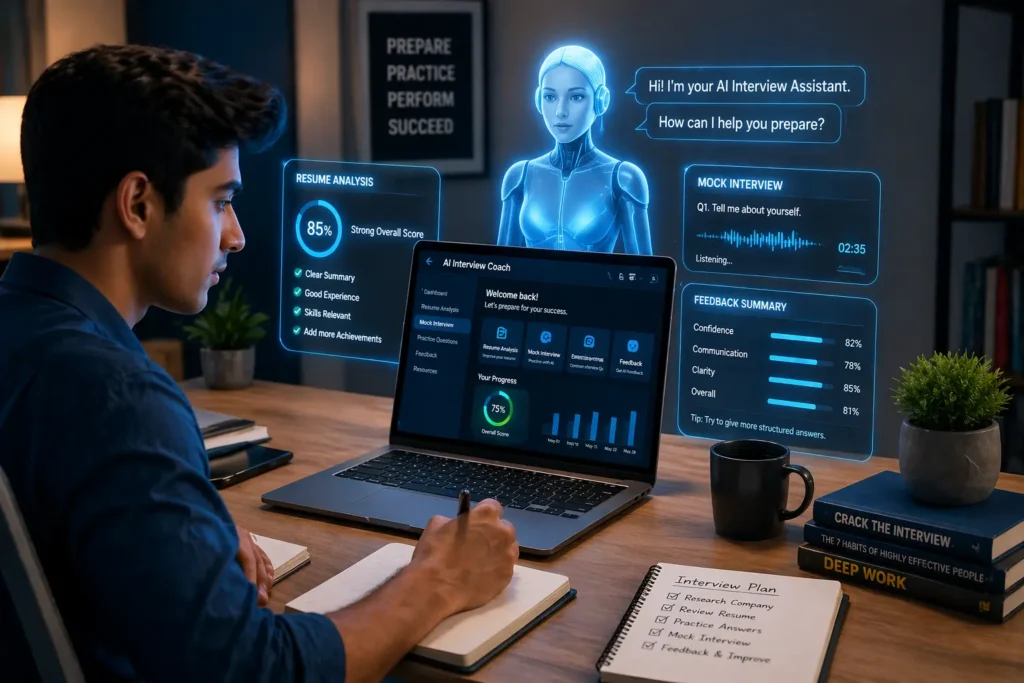
Why This Matters
Different roles have different interview patterns. You need job-specific questions.
How to Do It
Use AI tools to generate questions based on:
- Job role
- Experience level
- Industry
Example prompt:
“Generate 20 interview questions for a [job role] including behavioral, technical, and situational questions.”
What You’ll Get
- Common HR questions
- Role-specific questions
- Scenario-based questions
Step 2: Practice Mock Interviews with AI
The Problem
Reading answers is not real practice.
The Solution
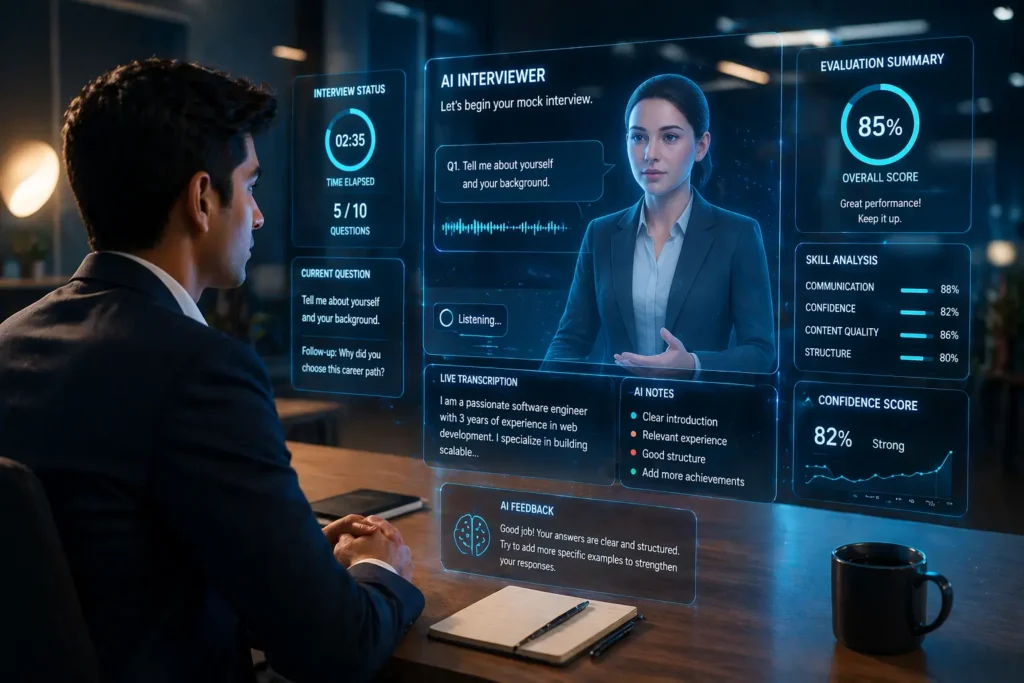
Simulate real interviews using AI.
How to Practice
- Ask AI to act as an interviewer
- Answer questions verbally
- Time your responses (30–90 seconds per answer)
Example prompt:
“Act as an interviewer and ask me one question at a time. Wait for my answer and then give feedback.”
Step 3: Optimize Your Answers Using AI
The Goal
Your answers should be:
- Clear
- Structured
- Relevant
- Impactful
Use the STAR Method
Situation
Task
Action
Result
Example:
Instead of saying:
“I handled a difficult client”
Say:
“I managed a challenging client situation by identifying their concerns, implementing a solution, and improving satisfaction by 25%”
Step 4: Get Feedback and Improve
Why This Is Important
Improvement comes from feedback, not repetition.
What AI Can Analyze
- Clarity of answers
- Use of keywords
- Confidence level (if practicing aloud)
- Structure of responses
Example prompt:
“Evaluate my answer and suggest improvements in clarity, structure, and impact.”
How to Implement This (Step-by-Step)
Day 1: Setup
- Identify your target job role
- Generate interview questions using AI
- Prepare initial answers
Day 2–3: Practice
- Conduct mock interviews
- Record your answers (optional)
- Review feedback
Daily Routine
- Practice 5–10 questions
- Improve answers
- Repeat weak areas
Weekly Improvement
- Analyze progress
- Refine communication
- Practice advanced questions
Real-World Example
Candidate A:
- Reads answers online
- No practice
- Nervous during interview
- Result: Rejected
Candidate B:
- Uses AI mock interviews
- Practices daily
- Improves answers with feedback
- Result: Confident performance + selection
Tools You Can Use
- ChatGPT
- Google Docs
- Notion
- Grammarly
Comparison Table: AI vs Traditional Preparation
| Factor | Traditional | AI-Based |
|---|---|---|
| Practice | Limited | Unlimited |
| Feedback | None | Instant |
| Customization | Low | High |
| Confidence | Low | High |
Pros and Cons of Using AI
Pros
- Personalized preparation
- Faster improvement
- Structured learning
- Better confidence
Cons
- Requires discipline
- Over-dependence risk
- Needs manual effort
Common Mistakes to Avoid
- Memorizing answers instead of understanding
- Ignoring practice
- Not using feedback
- Giving long, unclear answers
- Lack of confidence
Real Experience Tips
- Speak your answers out loud
- Keep answers concise (1–2 minutes)
- Use real examples
- Maintain eye contact (in real interviews)
👉 Important Insight:
Interview success depends more on communication than knowledge.
Conclusion
AI has transformed interview preparation from guesswork into a structured, data-driven process.
Instead of relying on random practice, you can now:
- Generate relevant questions
- Practice real scenarios
- Improve with feedback
If you stay consistent and follow this system, you will not only improve your performance but also increase your chances of getting selected.
Start practicing today, and turn interviews into opportunities instead of challenges.
FAQ
Q1: Can AI really help in interview preparation?
Yes, it provides structured practice and feedback.
Q2: How many questions should I practice daily?
5–10 questions are enough for consistent improvement.
Q3: Is AI better than human coaching?
AI is scalable and accessible, but both can be useful together.
Q4: Can beginners use this method?
Yes, it is especially helpful for beginners.
Q5: How long does it take to see improvement?
Usually within 1–2 weeks of consistent practice.