Introduction
Finding a job today is no longer just about submitting applications—it’s about speed, strategy, and smart execution. With hundreds of candidates applying for the same role, traditional job search methods are becoming outdated and inefficient. (AI Tools for Job Seekers)
Most job seekers struggle with:
- Writing strong resumes
- Applying to multiple jobs consistently
- Tracking applications
- Preparing for interviews
- Managing time effectively
The real issue is not effort—it’s the lack of a system.
This is where AI tools come in.
Artificial Intelligence can automate repetitive tasks, optimize your resume, help you apply faster, track your applications, and even prepare you for interviews. Instead of working harder, you can now work smarter.
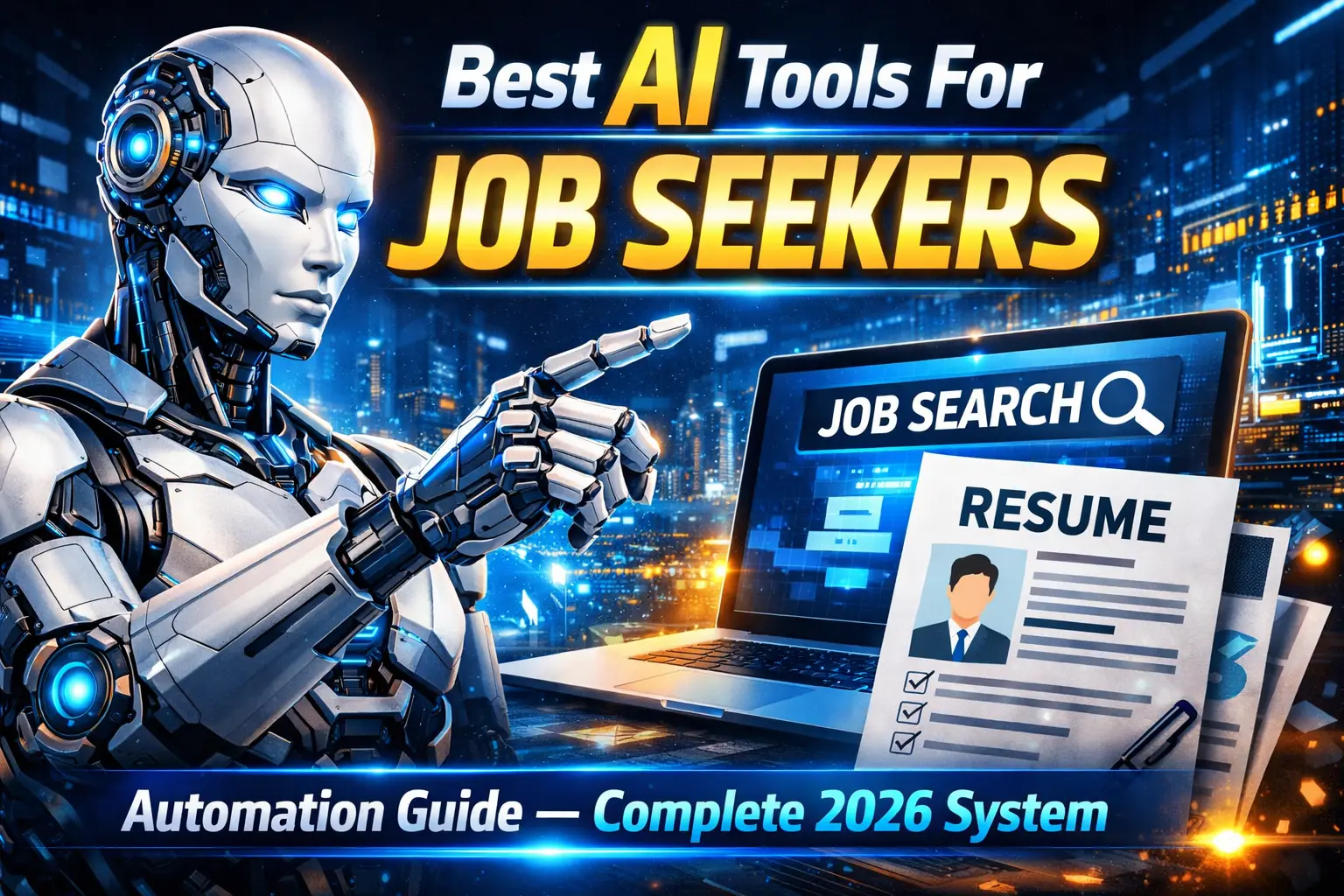
In this guide, you will discover the best AI tools for job seekers and how to use them together as a complete automation system to get results faster.
Why You Need AI in Your Job Search
The hiring process has evolved. Companies now use ATS (Applicant Tracking Systems), automated screening, and data-driven hiring methods.
If you are not using AI:
- Your resume may not pass ATS filters
- Your applications may be too slow
- You may miss opportunities
- Your preparation may be inconsistent
Using AI tools gives you a competitive advantage by making your process faster, more organized, and more effective.
AI Job Automation System Overview
To understand how these tools work together, let’s break the system into five parts:
- Resume Optimization
- Job Search & Matching
- Application Automation
- Tracking System
- Interview Preparation
Step 1: AI Tools for Resume Optimization
Your resume is the first step in getting noticed.
Best Tools:
- ChatGPT
- Rezi
- Teal
What They Do:
- Optimize resume content
- Add ATS-friendly keywords
- Improve bullet points
- Suggest better formatting
How to Use:
- Paste job description
- Ask AI to optimize your resume
- Edit and personalize output
Step 2: AI Tools for Job Search & Matching

Finding the right jobs is just as important as applying.
Best Tools:
- Indeed
- Glassdoor
What They Do:
- Suggest relevant jobs
- Provide company insights
- Show salary data
Smart Strategy:
- Apply to recent job postings
- Focus on roles matching your skills
- Avoid random applications
Step 3: AI Tools for Application Automation
Manual applications waste time and energy.
Best Tools:
- Simplify Jobs
- LazyApply
What They Do:
- Autofill applications
- Save time on repetitive tasks
- Help apply to multiple jobs quickly
Important Tip:
Use automation wisely—always review applications before submitting.
Step 4: AI Tools for Tracking Applications
Tracking is one of the most ignored but important steps.
Best Tools:
- Notion
- Google Sheets
What to Track:
- Job role
- Company
- Application date
- Status
- Follow-up
Why It Matters:
- Keeps you organized
- Helps improve your strategy
- Ensures timely follow-ups
Step 5: AI Tools for Interview Preparation
Getting an interview is just the beginning.
Best Tools:
- ChatGPT
- Grammarly
What They Do:
- Generate interview questions
- Simulate mock interviews
- Improve communication
How to Implement This (Step-by-Step)

Day 1–2: Setup
- Create your resume using AI
- Set up tracking system
- Identify target job roles
Daily Routine
- Search for 20–30 relevant jobs
- Customize resume using AI
- Apply using automation tools
- Update your tracker
Weekly Tasks
- Review performance
- Improve resume
- Practice interviews
Real-World Example
Candidate A:
- Uses manual methods
- No tracking
- Random applications
- Result: Low response rate
Candidate B:
- Uses AI tools
- Applies strategically
- Tracks everything
- Result: Higher interview calls
Comparison Table: AI Tools
| Category | Tool | Best For |
|---|---|---|
| Resume | ChatGPT | Content optimization |
| Resume | Rezi | ATS optimization |
| Job Search | Networking + jobs | |
| Automation | Simplify | Fast applications |
| Tracking | Notion | Organization |
Pros and Cons of AI Job Tools
Pros
- Saves time
- Improves efficiency
- Increases response rate
- Organizes workflow
Cons
- Learning curve
- Over-automation risk
- Requires manual review
Common Mistakes to Avoid
- Overusing automation
- Not customizing resumes
- Ignoring tracking
- Applying to irrelevant jobs
- Not preparing for interviews
Real Experience Tips
- Focus on quality applications
- Use AI as an assistant, not a replacement
- Keep improving your strategy
- Stay consistent
👉 Key Insight:
The job search process is no longer manual—it’s a system powered by tools.
Internal Linking Suggestions
You can also read:
- AI Resume Builder Guide (Step-by-Step)
- How to Prepare for Job Interviews Using AI
- How to Use AI to Get a Job Faster
Conclusion
AI tools have completely transformed how job searching works. Instead of struggling with outdated methods, you can now automate and optimize your entire process.
By combining resume optimization, smart applications, tracking, and interview preparation, you create a powerful system that increases your chances of success.
The key is not just using tools—but using them strategically.
Start building your AI-powered job search system today and take control of your career growth.
FAQ
Q1: Are AI tools necessary for job search?
Not mandatory, but highly beneficial in today’s competitive market.
Q2: Can AI fully automate job applications?
Partially, but manual review is still important.
Q3: Which AI tool is best for beginners?
ChatGPT is the easiest and most flexible tool.
Q4: How many jobs should I apply to daily?
20–30 targeted applications are recommended.
Q5: Is automation safe to use?
Yes, if used responsibly and ethically.