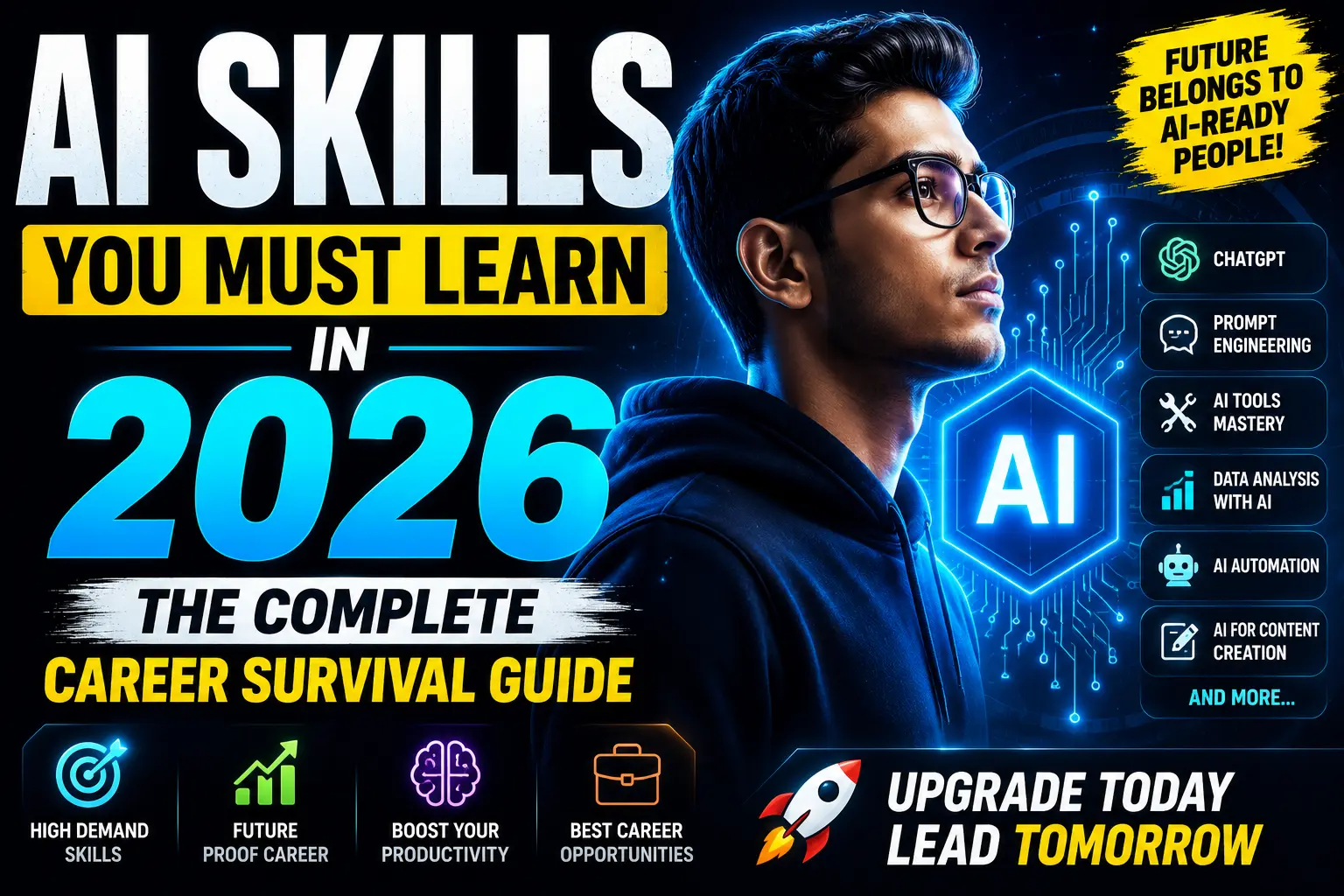
You have two options in 2026:
Option A: Learn AI skills and become 3-10x more valuable in your career.
Option B: Ignore AI and watch others get promoted, higher salaries, and better jobs.
Here’s what the data shows:
According to LinkedIn’s 2025 Salary Report, professionals with AI skills earn 25-40% more than their non-AI-skilled counterparts in the same role. A McKinsey study found that 70% of companies will require AI competencies for advancement by 2026.
The kicker? You don’t need to be a data scientist or engineer.
The myth: “AI skills = advanced coding and mathematics.”
The reality: Most valuable AI skills in 2026 don’t require coding. They require understanding how to work with AI, ask the right questions, interpret results, and apply AI thinking to your specific field.
Here’s the challenge: With 1,000+ AI courses flooding the market, how do you know which skills to actually learn? Which courses are worth your time? What ROI can you expect?
This comprehensive guide identifies the 7 essential AI skills for 2026, exactly what to learn, how long it takes, expected salary impact, real learning paths, and practical implementation strategies.
TABLE OF CONTENTS
- The AI Skill Landscape of 2026
- Technical AI Skills (For Coding-Inclined)
- Non-Technical AI Skills (For Everyone Else)
- Hybrid AI Skills (The Sweet Spot)
- Industry-Specific AI Skills
- Real Professionals Who Learned AI Skills
- Your Complete Learning Roadmap
1. THE AI SKILL LANDSCAPE OF 2026
The Skills Matrix
AI skills in 2026 fall into three categories:
Tier 1: AI Literacy (EVERYONE needs this)
- Understanding what AI is and what it can’t do
- Knowing how to prompt AI tools effectively
- Recognizing AI limitations and biases
- Using AI tools in your work
- Time to learn: 4-6 weeks
Tier 2: AI Specialization (Career accelerators)
- Prompt engineering (AI optimization)
- AI data interpretation
- AI implementation in your industry
- Leading AI adoption
- Time to learn: 2-4 months
Tier 3: Advanced AI (For those pursuing AI careers)
- Machine learning engineering
- AI model training
- Advanced prompt engineering
- AI research and development
- Time to learn: 6-18 months (degree/intensive)
Which Tier Do You Need?
Your situation → Recommended tier
“I want to stay relevant in my current job”
→ Tier 1 (AI Literacy) – 4-6 weeks
“I want to advance/get promoted”
→ Tier 2 (AI Specialization) – 2-4 months
“I want to change careers into AI”
→ Tier 3 (Advanced) – 6-18 months
“I want maximum career flexibility”
→ Tier 1 + Tier 2 (Complete foundation) – 3-4 months total
Why 2026 Is Different
Three factors make AI skills matter NOW (not in 2030):
1. AI Is Already Here
- ChatGPT: 2+ billion users
- Claude, Gemini: billions more
- Tools integrated into workplace software
- Your company is probably using AI tools right now
2. Early Adopter Advantage
- First 20% who learn these skills get best jobs
- Next 30% get good jobs
- Later 50% compete for remaining roles
- 2026 is still early—you can be in the first group
3. Skill Lifecycle
- Basic AI literacy: 3-5 year useful life
- Specialization: 5-8 year advantage
- Advanced skills: 8-12 year career impact
- Learning NOW means advantage through 2030+
2. TECHNICAL AI SKILLS (FOR CODING-INCLINED)
Skill #1: Prompt Engineering (HIGHEST ROI)
What is it? The art and science of asking AI questions effectively to get the results you want.
Why it matters:
- $120,000-$200,000+ salary potential
- 89% job growth rate (fastest growing skill)
- Applicable to ANY field
- Lowest barrier to entry (no coding required)
What you learn:
- How LLMs work (conceptually)
- Effective prompt structures
- Chain-of-thought reasoning
- Role-playing and context setting
- Advanced techniques (few-shot learning, etc.)
- Evaluating AI outputs
Time to competence: 6-8 weeks Free resources:
- DeepLearning.AI “Prompt Engineering for Developers”
- OpenAI Prompt Engineering Guide
- YouTube: “Advanced Prompting Techniques”
Time to expertise: 3-4 months (with daily practice)
Real-world application:
Before Prompt Engineering skill:
“Write a blog post about AI” → Mediocre result (generic, 2000 words of fluff)
After Prompt Engineering skill:
“Write a blog post about AI for [specific audience] with [specific angle],
include [data sources], structure as [format], tone should be [style]”
→ Excellent result (specific, targeted, publication-ready)
Time difference: 30 minutes vs. 2 hours
Quality improvement: 50-100%
ROI: $2,000-$5,000/month additional income (freelance) or $15,000-$30,000/year salary bump
Skill #2: AI Data Interpretation
What is it? Understanding how to interpret AI-generated insights and turn them into business decisions.
Why it matters:
- $130,000-$170,000 salary range
- Every company needs this
- High-value skill (not easily automated)
- Bridge between data and decision-making
What you learn:
- How to understand AI analysis results
- Identifying accuracy and limitations
- Statistical thinking (basic)
- Translating data into actions
- Critical evaluation of AI outputs
- Building dashboards and reports
Time to competence: 8-10 weeks Prerequisites: Basic data understanding (not coding required)
Free resources:
- Google’s “Data Analytics Certificate” (free basics)
- Coursera “Statistics for Data Analysis”
- YouTube: “Data Interpretation Fundamentals”
Real-world application:
Scenario: Your company uses AI to predict customer churn
Without AI Data Interpretation skill:
“Here are predictions: 500 customers will leave”
→ Don’t know what to do with this info
With AI Data Interpretation skill:
“These 500 customers have pattern X. Historical data shows Y intervention
reduces churn by Z%. Recommended action: Focus on these 100 highest-value customers
with intervention strategy A.”
→ Actionable strategy, measurable ROI
ROI: $20,000-$40,000/year salary increase
Skill #3: Basic Python for AI
What is it? Using Python to work with AI models, automate AI tasks, and integrate AI into workflows.
Why it matters:
- $140,000-$180,000+ salary
- Complements other AI skills
- Enables automation
- Increases job opportunities
What you learn:
- Python basics (variables, loops, functions)
- Working with APIs (ChatGPT, Claude, etc.)
- Data handling basics (pandas)
- Building AI workflows
- Automation scripts
Time to competence: 12-16 weeks (if starting from zero) Time to usefulness: 8 weeks (can build useful tools)
Paid resources:
- Codecademy “Python for AI” ($40)
- Udemy “Complete Python for AI” ($50-100)
- Coursera “Python for Data Science” ($50/month)
Real-world application:
Example: Integration workflow
Without Python:
“I need to use ChatGPT data in my spreadsheet”
→ Manual copy-paste work daily
With Python:
“`python
import openai
import pandas as pd
Automate: Run ChatGPT analysis, save results, integrate into report
Time: 30 minutes to write script, then automatic daily
ROI: $30,000-$50,000/year salary increase (combined with other skills)
3. NON-TECHNICAL AI SKILLS (FOR EVERYONE)
Skill #4: AI Literacy & Fundamentals
What is it?
Understanding AI: how it works, what it can do, limitations, biases, and ethics.
Why it matters:
– Foundation for all other skills
– Required by 72% of employers
– Differentiates you from non-AI-aware professionals
– Essential for informed decision-making
What you learn:
– What is AI/machine learning (high level)
– How LLMs are trained
– Limitations and failure modes
– Bias and fairness
– Ethical considerations
– Responsible AI use
– AI in your specific industry
Time to competence: 4-6 weeks
Cost: Free to $200
Free resources:
– DeepLearning.AI “AI for Everyone” (free, 5 hours)
– Google “Generative AI for Everyone” ($39, 3 weeks)
– YouTube: “AI Explained” channel (comprehensive)
**Real-world application:**
Scenario: Your company is considering AI implementation
Without AI Literacy: “We should implement AI because everyone is” → Uninformed decision, potential failures
With AI Literacy: “AI can help with [specific tasks]. Limitations: [these]. Success requires: [data quality, human oversight, ethical guardrails] ROI expectation: realistic timeline” → Informed strategy, better outcomes
**ROI:** $10,000-$20,000/year salary increase (in combined skillset)
Skill #5: AI for Your Specific Role
What is it?
Understanding how to apply AI to your specific job (marketing, finance, operations, etc.).
Why it matters:
– Immediate applicability
– Fastest path to productivity gains
– Differentiates you in your industry
– Multiplies your value 2-3x
Examples by role:
Marketers: AI for content, copywriting, analytics, audience analysis
Salespeople: AI for lead scoring, email drafting, proposal generation
Accountants: AI for bookkeeping, tax optimization, fraud detection
HR: AI for recruiting, engagement prediction, bias detection
**Operations:** AI for process optimization, forecasting, automation
Time to competence:6-8 weeks (once you know basic AI literacy)
Cost $100-$500 (role-specific courses)
**Finding resources:**
– Search “[your role] + AI skills course”
– LinkedIn Learning (by job title)
– Coursera specializations (by field)
– Industry-specific training platforms
**Real-world application:**
Marketing example:
Without AI for Marketing: “Write blog post about AI” → 4 hours manual work
With AI for Marketing: “ChatGPT draft: 30 min, AI research: 15 min, AI images: 10 min, edit: 30 min” → 1.5 hours total, better quality → Can produce 3x more content in same time
**ROI:** $15,000-$35,000/year increase (by multiplying productivity)
—
4. HYBRID AI SKILLS (THE SWEET SPOT)
Skill #6: AI Leadership & Implementation
**What is it?**
Leading AI adoption in your organization, managing AI projects, building AI strategies.
**Why it matters:**
– $160,000-$250,000+ salary
– Most valuable skill set
– Permanent job security
– Leadership opportunities
**What you learn:**
– AI strategy development
– Change management
– Building AI teams
– Managing AI projects
– Ethics and governance
– ROI measurement
– Vendor evaluation
**Prerequisites:**
– AI literacy (Skill #4)
– Industry-specific knowledge
– Leadership experience (helpful, not required)
**Time to competence:** 10-12 weeks
**Cost:** $500-$2,000
**Resources:**
– “AI Strategy for Organizations” courses (Coursera, LinkedIn)
– Industry-specific AI leadership programs
– Corporate training programs
**Real-world application:**
Scenario: Your company needs AI implementation strategy
With AI Leadership skills, you can:
- Assess current state
- Identify high-impact opportunities
- Build implementation roadmap
- Manage change and adoption
- Measure ROI
Value created: $500,000-$5,000,000+ for company Your career value: Indispensable leader
**ROI:** $50,000-$100,000+ salary increase or promotion to leadership
—
### Skill #7: AI Ethics & Responsible AI
**What is it?**
Understanding and implementing ethical AI, bias detection, responsible practices, and compliance.
**Why it matters:**
– Rapidly growing field (no talent supply yet)
– $140,000-$200,000 salary
– Protection against AI failures
– Competitive advantage (trust)
**What you learn:**
– Bias and fairness in AI
– Ethical frameworks
– Transparency and explainability
– Privacy and security
– Regulatory compliance (GDPR, etc.)
– Responsible AI governance
– Risk assessment
**Time to competence:** 8-10 weeks
**Cost:** $300-$800
**Resources:**
– MIT “AI Ethics” course (free online)
– “Responsible AI” specialization (Coursera)
– “Ethics in AI” (edX)
**Real-world value:**
– Prevents costly AI failures
– Protects company reputation
– Ensures compliance
– Builds customer trust
**ROI:** $30,000-$60,000/year increase (as specialized expertise)
—
## 5. INDUSTRY-SPECIFIC AI SKILLS {#section-5}
### AI Skills by Industry
**Healthcare:**
– Medical AI interpretation
– Patient data analysis
– Clinical decision support
– Medical imaging understanding
– Salary impact: +$40,000-$80,000
**Finance:**
– Financial prediction models
– Risk analysis
– Fraud detection
– Trading algorithm understanding
– Salary impact: +$50,000-$120,000
**Legal:**
– Legal document analysis
– Contract review
– Legal research automation
– Compliance monitoring
– Salary impact: +$35,000-$75,000
**Retail/E-commerce:**
– Customer behavior prediction
– Inventory optimization
– Pricing strategy
– Recommendation systems
– Salary impact: +$25,000-$60,000
**Manufacturing:**
– Predictive maintenance
– Quality control
– Supply chain optimization
– Production forecasting
– Salary impact: +$30,000-$70,000
—
6. REAL PROFESSIONALS WHO LEARNED AI SKILLS

Case Study 1: Software Developer → AI Engineer
Background:
Michael, software developer, 7 years experience, salary $110,000. Worried about AI replacing programmers.
**Decision:** Learn prompt engineering + basic Python + AI leadership instead of competing with junior developers.
**Learning Plan (4 months):**
– Month 1: AI literacy + prompt engineering (online course)
– Month 2: Python for AI integration
– Month 3: AI implementation project (personal)
– Month 4: AI leadership + strategy
**Implementation:**
– Built AI-enhanced development workflow
– Created internal tools for team
– Led company’s AI adoption initiative
**Results (12 months later):**
– Promoted to “AI Engineering Lead”
– Salary: $110,000 → $165,000 (+50%)
– Team: Managing 3 engineers
– Job security: Increased significantly
– Career: Clear path to CTO/technical leadership
**Key insight:** Instead of competing with AI, he positioned himself as the bridge between AI and human engineering.
—
### Case Study 2: Marketing Manager → AI-Powered Marketer
**Background:**
Jessica, marketing manager, 8 years experience, salary $85,000. Felt content creation was becoming commoditized.
**Decision:** Master AI for marketing to multiply productivity.
**Learning Plan (8 weeks):**
– Week 1-2: AI literacy for marketers
– Week 3-4: Advanced prompt engineering (marketing-focused)
– Week 5-6: AI tools for marketing (ChatGPT, Midjourney, etc.)
– Week 7-8: Implementation + results measurement
**Implementation:**
– Content creation: 5 pieces/week → 15 pieces/week (3x)
– Campaign performance: Improved 40% (better targeting with AI insights)
– Time freed: 20 hours/week for strategy
**Results (12 months later):**
– Promoted to “Content Strategy Director”
– Salary: $85,000 → $110,000 (+29%)
– Team: Expanded 3 person team
– Portfolio: Significantly stronger (more content, better quality)
– Career: Now pursuing director-level positions
**Key insight:** AI multiplied her productivity so she could handle more without burnout.
Case Study 3: Data Analyst → AI Data Interpretation Specialist
**Background:**
David, data analyst, 5 years experience, salary $72,000. Competing with junior analysts who code better.
**Decision:** Specialize in interpreting AI-generated insights for business decisions.
**Learning Plan (10 weeks):**
– Weeks 1-2: AI literacy
– Weeks 3-5: Statistical thinking + data interpretation
– Weeks 6-8: AI-specific interpretation (understanding ML outputs)
– Weeks 9-10: Building value as interpreter
**Implementation:**
– Interpreted AI predictions for business
– Translated complex findings into actions
– Reduced decision-making time 60%
– Increased ROI of company’s AI investments
**Results (12 months later):**
– New role: “AI Insights Manager”
– Salary: $72,000 → $105,000 (+46%)
– Impact: Became trusted advisor to C-suite
– Career: Positioned for director path
Key insight:By specializing in what AI can’t fully do (interpretation + context), he became more valuable than junior developers who could code.
—
7. YOUR COMPLETE LEARNING ROADMAP
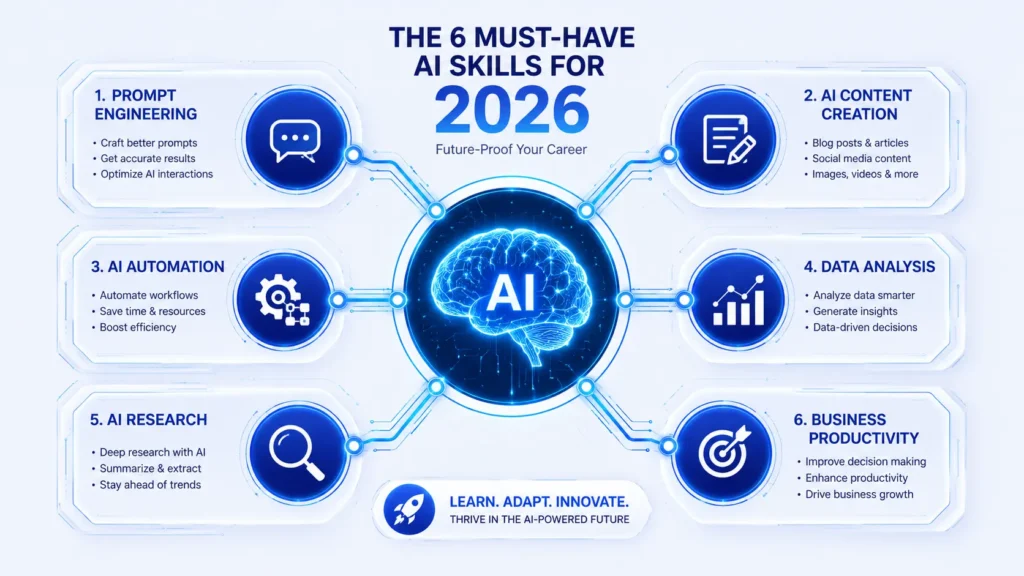
The 12-Week Fast-Track Path
For anyone wanting maximum career impact in minimum time:
Week 1-2: AI Literacy Foundation
Goal: Understand AI, how it works, what it can’t do.
Time: 5-7 hours/week (35-50 minutes daily)
Resources:
– DeepLearning.AI “AI for Everyone” (free, 5 hours)
– YouTube: “Crash Course AI” (10 videos, 10 hours)
– Read: One medium article about AI daily
Deliverable: Understanding of AI fundamentals
Week 3-6: Prompt Engineering Mastery**
Goal:Master asking AI questions effectively.
Time: 8-10 hours/week (1-2 hours daily)
Resources:
– DeepLearning.AI “Prompt Engineering for Developers” (free, 1 hour)
– OpenAI Prompt Engineering Guide (self-study)
– Practice: Daily prompting experiments
– Paid course option: Udemy “Advanced Prompting” ($50)
Daily Practice:
– 20 min: Learning new techniques
– 40 min: Practicing prompts in ChatGPT/Claude
– 30 min: Optimizing prompts for better results
Deliverable: Portfolio of 20+ optimized prompts showing ROI improvement
Week 7-10: Role-Specific AI Application
Goal: Master AI in your specific job.
Time: 8-10 hours/week
Choose your track:
Marketing Track:
– AI for content creation
– AI for copywriting
– AI for research and analysis
– Tools: ChatGPT, Midjourney, Perplexity
Finance Track:
– AI for financial analysis
– AI for forecasting
– AI for automation
– Tools: ChatGPT, Google Sheets + Gemini
Sales Track:
– AI for email/messaging
– AI for lead scoring
– AI for proposal generation
– Tools: ChatGPT, Copy.ai, HubSpot AI
Operations Track:
– AI for process optimization
– AI for forecasting
– AI for automation
– Tools: ChatGPT, Make.com, Zapier + AI
Resources:
– Industry-specific Udemy course ($30-50)
– LinkedIn Learning (if available through employer)
– YouTube tutorials for your role + AI
– Practice: Apply daily to real work tasks
Deliverable:5 projects showing AI improvement in your role
Week 11-12: Leadership & Next Steps
Goal: Position yourself as an AI expert in your field.
Time: 5-7 hours/week
Actions:
– Document your AI projects and results
– Create case study showing ROI
– Present to your team
– Propose AI initiative at work
– Build portfolio or blog
Deliverable:Concrete evidence of your AI expertise and value
Alternative Paths by Goal
Path A: Job Security (Minimum investment)**
Timeline: 6 weeks Skills: AI literacy + Prompt engineering Expected ROI: 5-15% productivity increase, job security Effort: 5-7 hours/week
Path B: Career Advancement (Moderate investment)
Timeline: 12 weeks Skills: AI literacy + Prompt engineering + Role-specific AI + Basic leadership Expected ROI: 30-50% productivity increase, potential promotion Effort: 8-10 hours/week Career impact: Significant (get promoted, higher salary)
Path C: Career Change (Major investment)
Timeline: 4-6 months Skills: AI literacy + Specialization (prompt engineer, data interpreter, AI leadership) Expected ROI: New career path, $20,000-$50,000 salary increase Effort: 15-20 hours/week Career impact: Major transformation
FREQUENTLY ASKED QUESTIONS
Q1: Do I need to know coding to learn AI skills?
A:No. 80% of valuable AI skills don’t require coding. Prompt engineering, AI literacy, AI leadership—all learnable without coding. Python helps but isn’t essential.
Q2: How long will these skills be relevant?
A:
– AI literacy: 3-5 years useful life
– Specialization: 5-8 years
– Leadership skills: 8-12+ years (foundation)
– Skills keep evolving, but foundation remains valuable
Q3: What’s the ROI on learning these skills?
A:
– Low: 10-20% productivity increase, $5,000-$15,000/year
– Medium: 30-50% productivity increase, $20,000-$50,000/year
– High: 2-3x effectiveness, $50,000-$100,000+ increase or new opportunities
Q4: Can I learn these while working full-time?
A: Yes. 5-10 hours/week is achievable for most people. Mix of learning (3-4 hours) + practice (5-7 hours) spreads easily throughout week.
Q5: What if I’m older/changing careers?
A: AI skills don’t care about age. Anyone can learn. In fact, experienced professionals + AI skills = highly valuable combination (you have domain knowledge + new tools).
Q6: Which skill should I learn first?
A: Always start with AI Literacy (Skill #4). It takes 4-6 weeks and is foundation for everything else.
Q7: Is it too late to start learning AI skills?
A:Not at all. 2026 is still early. You’re not competing with AI experts from 2023—you’re competing with professionals who ignore AI. That’s a lower bar.
Q8: What about job security? Won’t AI eliminate my job anyway?
A: Jobs being eliminated are those doing nothing to adapt. Professionals actively learning AI skills are MORE secure, not less. You become indispensable.
EXPERT INSIGHTS
What Hiring Managers Say
The gap isn’t between people with AI skills and without. It’s between people learning AI and people ignoring it.
— HR Director, Fortune 500 Tech Company
We’re promoting people with AI skills 30% faster than non-AI peers.
— VP of Operations, Mid-size SaaS Company
The most valuable employees are experienced people who also know AI. Not AI experts—people who know their job PLUS AI.”
— CEO, Growth-Stage Startup
Industry Data
LinkedIn 2026 Skills Report:
– AI is fastest-growing skill category (+85% YoY)
– Professionals with AI skills earn 25-40% more
– AI skills shortage: 5 qualified candidates per 100 open roles
Gartner Workforce Report:
– 72% of companies need AI skills
– Only 20% of employees have AI literacy
– Massive gap = opportunity for those who skill up
McKinsey Jobs Study:
– AI specialists: 15+ year runway (demand exceeds supply)
– AI-adjacent roles: 8-12 year advantage
– Non-AI roles: Uncertain future
CONCLUSION
The choice is simple:
Option A: Learn AI skills by end of 2026. Become 2-3x more valuable, earn 25-50% more, have career security through 2035+.
Option B: Don’t learn AI skills. Watch others get promoted, higher salaries, better opportunities. Rely on luck that your job isn’t affected.
Here’s what we know for certain:
– AI is here and accelerating
– Skills matter more than anything else
– 2026 is still early (first-mover advantage exists)
– Anyone can learn these skills (not reserved for geniuses)
– ROI is clear (25-100%+ increase in value)
The investment is small (4-12 weeks, $200-$2,000). The return is massive (career advantage for decade+).
Start this week : Pick one skill. Spend 30 minutes today learning AI literacy. That’s all it takes to begin the journey.
Your future self (in 2030) will thank you for deciding to learn AI skills today.