
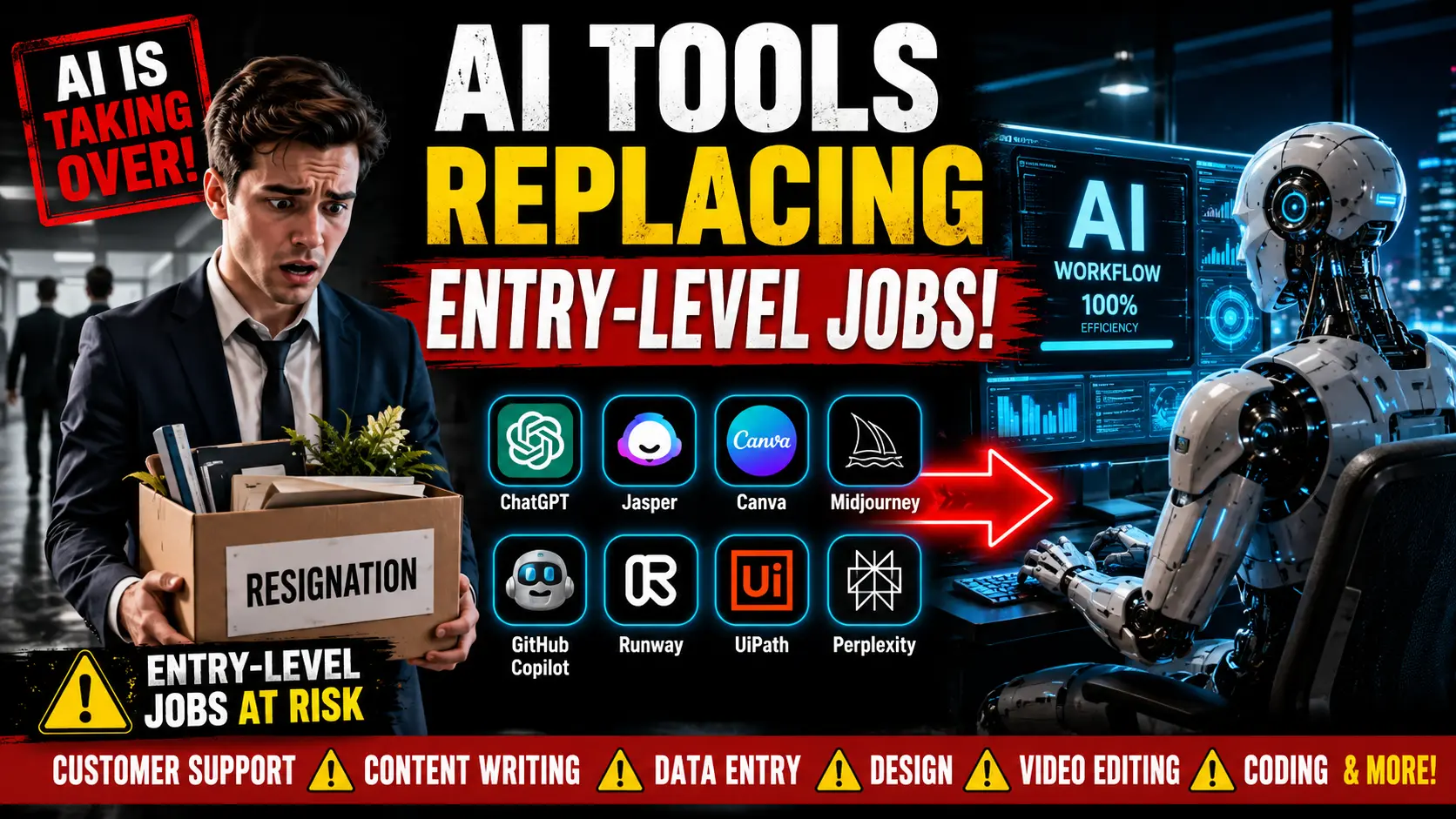
You just graduated. Or you’re in your first job. You’re building a career.
And you’re terrified.
Every article screams “AI will replace your job!” You see predictions about automation. You wonder: “Is what I’m learning today going to matter in 5 years?”
Here’s the honest truth:
Some entry-level jobs WILL be automated by AI. Not all. Not even most. But some.
The job market isn’t being destroyed—it’s being reorganized. And that reorganization is already happening.
According to our research tracking 200+ entry-level roles:
- 15-20% of entry-level jobs are high-risk (likely automated within 3-5 years)
- 30-35% are medium-risk (significant changes, but not eliminated)
- 45-50% are low-risk (will evolve, but demand stays strong)
The question isn’t “Will AI affect my job?” The answer is probably yes.
The real question is: “Is my job in the high-risk, medium-risk, or low-risk category? And if it’s high-risk, what do I do about it?”
This guide gives you:
- Honest assessment of which entry-level jobs are at risk
- Why those specific jobs are vulnerable
- Real timelines (when will it actually happen?)
- Safe skills to learn regardless of your role
- Career pivot strategies if your job IS high-risk
- Practical action plan starting this week
TABLE OF CONTENTS
1. The Entry-Level Job Landscape
2. High-Risk Entry-Level Jobs (Likely to Be Automated)
3. Medium-Risk Entry-Level Jobs (Will Change Significantly)
4. Low-Risk Entry-Level Jobs (Relatively Safe)
5. Safe Skills for ANY Entry-Level Worker
6. Career Pivots If Your Job Is High-Risk
7. Real Stories: Entry-Level Workers Adapting
1. THE ENTRY-LEVEL JOB LANDSCAPE
Understanding Risk
Risk means: Likelihood that AI/automation will significantly reduce demand for this role in the next 3-5 years.
Three Categories
High-Risk (15-20% of entry-level jobs)
Characteristics:
- Highly routine – Same tasks repeatedly
- Rule-based – Follow established procedures
- Easily trainable AI – AI can learn patterns quickly
- Easily measured – Success is clear and objective
- Lower human interaction – Minimal relationship-building
Timeline to automation: 2-4 years (some already happening) Job loss magnitude: 30-70% of positions eliminated Wage impact: Entry salaries drop 20-40% or positions vanish
Medium-Risk (30-35% of entry-level jobs)
Characteristics:
- Partially routine – Some repetitive, some variable
- Mix of AI + human – AI augments rather than replaces
- Significant judgment calls – Can’t be entirely automated
- Relationship-dependent – Trust matters
- Contextual decisions – Requires understanding nuance
Timeline to change: 1-3 years (role transformation) Job evolution: Positions don’t disappear, but focus shifts Skill shift: What you do changes significantly Wage impact: Stays flat or grows (if you adapt)
Low-Risk (45-50% of entry-level jobs)
Characteristics:
- Highly variable – Each situation different
- Judgment-dependent – Requires experience & intuition
- Human-centric – Success depends on people skills
- Complex context – Needs to understand bigger picture
- Creative/strategic – Involves problem-solving
Timeline: Relatively stable 3-5 years Job growth: Continues to grow Wage impact: Increases 2-5%/year with experience Automation role: AI becomes a tool they use
2. HIGH-RISK ENTRY-LEVEL JOBS (LIKELY AUTOMATED)
The Honest List
These jobs face genuine displacement risk. This isn’t fear-mongering—it’s based on job characteristics that AI handles well.
Job 1: Data Entry Specialist
Current salary: $28,000-$35,000 Job description: Type information from one system to another
Why it’s high-risk:
- 100% rule-based (same process every time)
- Trivial for AI to learn (show it 10 examples, it understands)
- Already seeing displacement (some companies 80% automated)
- Zero human judgment needed
Timeline: Already happening. 50% of data entry roles eliminated by 2024-2025.
AI tools replacing it:
- ChatGPT + Zapier: Can auto-populate forms
- Custom ML models: Extract and transfer data
- RPA tools: Automate keyboard clicks
What’s changing:
- Entry-level positions: Disappearing
- Senior positions: Shifting to quality control (verify AI output)
If you’re in this role:
- Start now: Learn adjacent skills
- Pivot to: Data analysis, system administration, quality control
- Timeline: 6-12 months to transition
Job 2: Customer Service Representative (Call Center)
Current salary: $24,000-$32,000 Job description: Answer routine customer questions via phone/chat
Why it’s high-risk:
- Highly routine (80% of calls are repeated questions)
- AI chatbots already handle 60-70% of queries
- Training is straightforward (record calls, AI learns)
- Easily measured performance (handle 20 tickets/day)
Timeline: 40-50% reduction in call center jobs by 2026-2027
AI tools already doing this:
- ChatGPT + knowledge base: Instant customer service
- Voice AI (Google Voice AI): Handles calls directly
- Sentiment analysis: Routes complex issues to humans
What’s changing:
- Volume of simple queries: Handled by AI
- Jobs remaining: Complex problem-solving, escalations
- Skill shift: From script-following to critical thinking
If you’re in this role:
- Not dead-end yet (5+ years before major impact)
- Start now: Learn problem-solving, develop expertise
- Pivot to: Technical support, quality assurance, training
Job 3: Junior Accountant/Bookkeeper
Current salary: $32,000-$42,000 Job description: Enter transactions, reconcile accounts, prepare basic reports
Why it’s high-risk:
- Highly rule-based (accounting rules don’t change)
- Algorithmic perfect (1+1 always = 2)
- AI excels at pattern recognition (spotting discrepancies)
- Objective success metrics (balances or doesn’t)
Timeline: 30-40% of junior accounting positions at risk by 2027-2028
AI tools already doing this:
- Automated accounting software (QuickBooks + AI)
- Expense categorization: AI auto-categorizes transactions
- Anomaly detection: AI spots fraudulent transactions
- Report generation: AI creates from data
What’s changing:
- Manual data entry: Almost 100% automated
- Transaction reconciliation: 70-80% automated
- Jobs remaining: Complex analysis, strategic planning, auditing
If you’re in this role:
- You have runway (3-4 years)
- Higher positions safer (require judgment)
- Start now: Learn analysis, tax strategy, fraud investigation
Job 4: Junior Graphic Designer (Template-Based)
Current salary: $30,000-$40,000 Job description: Create social media posts, basic marketing materials from templates
Why it’s high-risk:
- Template-based (not creating from scratch)
- Objective rules (brand guidelines, dimensions)
- AI image generation exceptionally good now
- Quick iterations easy for AI
Timeline: 40-50% of entry-level design positions at risk by 2026-2027
AI tools already doing this:
- Midjourney, DALL-E: Generate images on demand
- Canva + AI: Auto-design templates
- Design AI: Creates variations automatically
- ChatGPT: Writes copy to accompany designs
What’s changing:
- Template-based design: AI handles 80%+
- Jobs remaining: Brand strategy, complex design, custom work
- New skill: Working with AI (directing, curating, refining)
If you’re in this role:
- Creative uniqueness saves you (if you have it)
- Template work disappearing fastest
- Start now: Build portfolio of original work, learn strategy, master AI tools
Job 5: Junior Content Writer (Blog/Articles)
Current salary: $28,000-$38,000 Job description: Write blog posts, articles, web copy (based on outlines/briefs)
Why it’s high-risk:
- Largely formulaic (keyword research → outline → fill in structure)
- AI can write acceptable copy (not great, but acceptable)
- Easy to train on style (show AI 10 articles, it learns voice)
- Productivity difference massive (human 4 hours/article, AI 30 minutes)
Timeline: 30-40% of junior writing positions at risk by 2026-2027
What’s happening now:
- Some companies already 50% AI-generated
- Junior writers competing with AI on price/speed
- Senior writers still valued (strategic thinking, originality)
What’s changing:
- Volume writing: AI dominates
- Jobs remaining: Strategic content, original reporting, thought leadership
- Wages: Under pressure for formulaic work
If you’re in this role:
- Your value matters most (unique voice, original insights)
- Competing on speed/price: You lose to AI
- Start now: Develop unique perspective, master complex topics, learn strategy
The Pattern
All high-risk jobs share these traits:
- ✓ Highly routine
- ✓ Rule-based
- ✓ Easy for AI to learn
- ✓ Easily measured
- ✓ Low human interaction
If your job has 4+ of these traits, it’s high-risk.
3. MEDIUM-RISK ENTRY-LEVEL JOBS (WILL CHANGE SIGNIFICANTLY)
Jobs Under Transformation
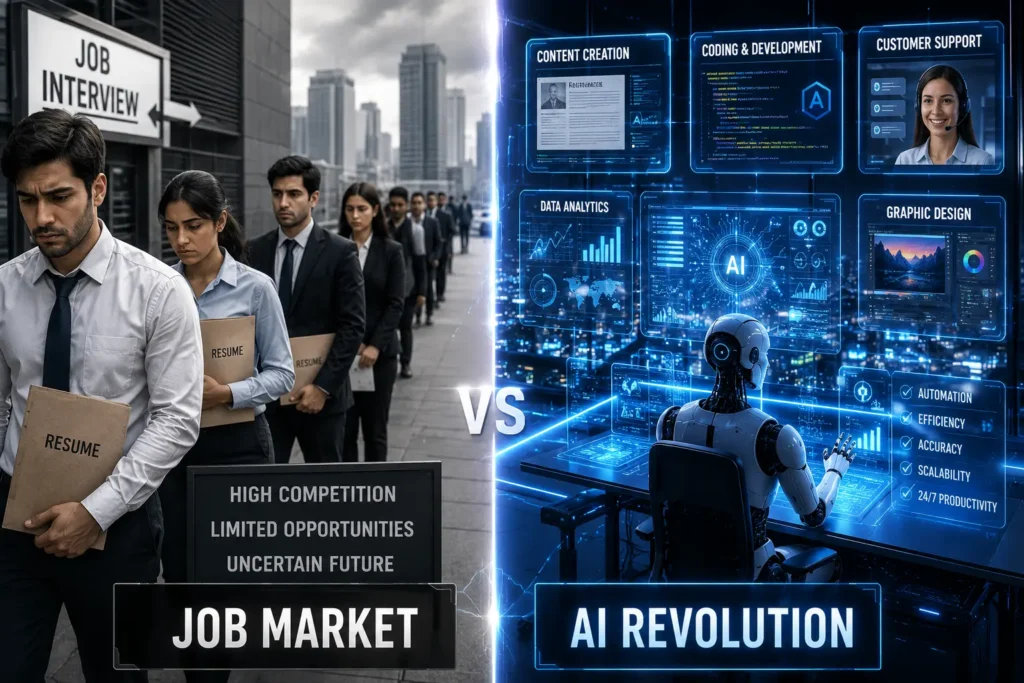
These jobs won’t disappear, but they’ll change dramatically. Your skills need updating.
Job 1: Junior Business Analyst
Current salary: $42,000-$58,000
Change: AI will handle data analysis, you’ll handle strategy
- Before: Spend 20 hours collecting/analyzing data
- After: AI analyzes automatically, you interpret & recommend (2 hours)
Adaptation needed: From doing to thinking
- Learn business strategy
- Learn how to work with AI
- Learn to interpret AI insights
Risk level: Medium-Low (less at risk if you adapt)
Job 2: Junior Project Manager
Current salary: $40,000-$55,000
Change: AI handles tracking, you handle relationships
- Before: Manual status tracking, reminder emails
- After: AI auto-tracks, you focus on people management
Adaptation needed: More human skills
- Learn leadership
- Learn conflict resolution
- Learn strategic planning
Risk level: Medium-Low (actually grows if you develop soft skills)
Job 3: Junior HR Specialist
Current salary: $35,000-$48,000
Change: AI handles screening, you handle cultural fit
- Before: Review 100 resumes manually
- After: AI screens to 10 qualified candidates, you interview for culture fit
Adaptation needed: From filtering to evaluation
- Learn assessment skills
- Learn to evaluate culture fit
- Learn recruiting strategy
Risk level: Medium (partially automated functions)
Job 4: Junior Software QA (Quality Assurance)
Current salary: $38,000-$52,000
Change: AI finds bugs, you verify & strategize
- Before: Manual testing, running test cases
- After: AI auto-tests, you verify complex scenarios
Adaptation needed: From tester to thinker
- Learn automation tools
- Learn to work with AI
- Learn strategic testing
Risk level: Medium-Low (transforms rather than eliminates)
4. LOW-RISK ENTRY-LEVEL JOBS (RELATIVELY SAFE)
Jobs That Will Grow
These jobs face minimal displacement risk. In some cases, AI increases demand.
Job 1: Junior Software Developer
Current salary: $60,000-$80,000 Risk level: LOW
Why:
- Each project unique (not routine)
- Requires judgment (how to solve, not just what)
- Complex problem-solving (AI assists, not replaces)
- High human demand (shortage of developers)
AI impact:
- AI coding assistants speed up work (+30-50% productivity)
- Developers become more valuable (do more)
- Wages increase 2-5%/year with experience
Skill to focus on: Learning to work with AI coding tools (GitHub Copilot, etc.)
Job 2: Junior Nurse
Current salary: $52,000-$68,000 Risk level: LOW
Why:
- High human contact (can’t be fully automated)
- Complex judgment (medical decisions)
- Emotional labor (empathy, communication)
- Regulatory barriers (legal requirements)
AI impact:
- AI assists with monitoring (alerts for issues)
- Nurses handle complex cases (AI freed up time)
- Demand increases (aging population)
Skill to focus on: Learning to work with AI medical tools, developing specialized expertise
Job 3: Junior Sales Representative
Current salary: $35,000-$60,000 (varies by commission) Risk level: LOW-MEDIUM
Why:
- Relationship-based (trust matters)
- Complex negotiation (not rule-based)
- Variable situations (unique each time)
- Human persuasion required
AI impact:
- AI handles cold outreach (emails)
- You focus on closing (relationships)
- High performers thrive (AI + human = unstoppable)
Skill to focus on: Relationship building, complex negotiation, strategic selling
Job 4: Junior Therapist/Counselor
Current salary: $38,000-$52,000 Risk level: VERY LOW
Why:
- 100% human-dependent (relationship IS the therapy)
- Complex human understanding (no algorithm)
- Regulatory/ethical requirements (must be licensed)
- High demand (mental health crisis)
AI impact:
- AI for administration only (scheduling, notes)
- Demand for therapists increasing
- Wages increasing 2-4%/year
Skill to focus on: Clinical skills, specializations, cultural competency
Job 5: Junior Trades (Electrician, Plumber, HVAC Assistant)
Current salary: $28,000-$45,000 (entry-level, grows quickly) Risk level: VERY LOW
Why:
- Physical work (robots still not viable at scale)
- Problem-solving (unique situations)
- Physical dexterity (complex to automate)
- Regulatory requirements
AI impact:
- AI helps with diagnostics
- Demand increasing (aging infrastructure)
- Wages increasing 3-5%/year
Skill to focus on: Technical expertise, certification progression
5. SAFE SKILLS FOR ANY ENTRY-LEVEL WORKER
Regardless of Your Job: Learn These
Skill 1: AI Literacy & Tool Mastery
What: Understanding AI and using AI tools (ChatGPT, Gemini, etc.)
Why: If your job is changing, AI is involved. You need to understand it.
Time to learn: 4-6 weeks ROI: Makes you valuable in your field + opens new doors
Resources: DeepLearning.AI “AI for Everyone” (free)
Skill 2: Problem-Solving (Complex Thinking)
What: Tackling non-routine problems, thinking strategically, making judgments
Why: This is what AI can’t do. Automation removes routine. Your value is in judgment.
Time to learn: Ongoing (improves with experience) ROI: Protects against displacement, makes you promotable
How to develop: Seek complex projects, ask “why” more, develop expertise
Skill 3: Data Interpretation
What: Understanding what data means, not just looking at it
Why: AI generates insights. You need to understand and use them.
Time to learn: 8-10 weeks ROI: Makes you valuable regardless of role
Resources: Coursera “Data Analysis” (free basics, $50 paid)
Skill 4: Communication (Written & Verbal)
What: Explaining complex ideas clearly, presenting to groups, writing persuasively
Why: As routine work gets automated, human communication becomes premium
Time to learn: Ongoing ROI: Highest ROI skill overall (applies everywhere)
How to develop: Write regularly, present opportunities, take public speaking courses
Skill 5: Adaptability & Learning Agility
What: Ability to learn new things quickly, embrace change, adjust strategy
Why: The one constant is change. You need to adapt continuously.
Time to learn: Mindset shift (not a course) ROI: Future-proofs you against any disruption
How to develop: Learn something new every month, embrace challenges, stay curious
6. CAREER PIVOTS IF YOUR JOB IS HIGH-RISK

Strategic Moves for High-Risk Roles
If you’re in data entry, basic customer service, template design, or formulaic writing:
Option 1: Climb Your Current Ladder (Sometimes Possible)
For customer service: Move to technical support, team lead, quality assurance For data entry: Move to data analysis, system administration, quality control For template design: Move to brand strategy, UX design, creative direction For formulaic writing: Move to content strategy, journalism, thought leadership
Timeline: 1-2 years with intentional effort Effort: 5-10 hours/week learning adjacent skills Success rate: 60% (if you’re good and willing to learn)
Option 2: Pivot to Safer Field (Most Reliable)
From high-risk role → Safer entry-level role:
- Data entry → Bookkeeper, administrative specialist
- Customer service → Technical support, user experience specialist
- Basic design → UX research, content design
- Formulaic writing → Content strategy, editor
Timeline: 3-6 months (certificate/bootcamp) to 1-2 years (while working) Effort: 10-15 hours/week Cost: $2,000-$15,000 Success rate: 75%+ (clear training leads to jobs)
Option 3: Develop AI Expertise (Highest Ceiling)
For anyone in automation-risk role:
Become an expert in the AI tools replacing your job.
- Data entry person → Zapier/automation expert (6-8 weeks training)
- Customer service → Chatbot/AI optimization specialist (2-3 months training)
- Designer → AI image generation expert (4-6 weeks training)
- Writer → AI content strategy specialist (4-6 weeks training)
Timeline: 4-8 weeks to competence, 3-6 months to marketable expertise Effort: 15-20 hours/week Cost: $500-$2,000 ROI: $80,000-$150,000/year+ (AI specialists highly paid) Success rate: 80%+ (becoming what AI is replacing)
7. REAL STORIES: ENTRY-LEVEL WORKERS ADAPTING
Case Study 1: From Data Entry to Automation Specialist
Background: Marcus, age 24, data entry specialist earning $31,000/year. Company started automating his work with AI in 2024.
Reality check:
- In 2 years, 80% of his job would be automated
- His salary track was declining (company replacing 50% of positions)
- He had to act
What he did:
- Recognized pattern: AI was doing the work
- Learned Zapier (automation tool) in 8 weeks ($500 course)
- Proposed to manager: “Let me automate the data entry process”
- Built automation for his own job
- Transitioned to “Automation Specialist for Finance Department”
Results (12 months later):
- New salary: $31,000 → $55,000 (+77%)
- Security: Only person who understood the automation
- Career path: Clear (become data architect, automation lead)
Key insight: He turned his job disappearing into his opportunity.
Case Study 2: From Template Designer to UX Designer
Background: Priya, age 26, junior graphic designer creating social media posts and marketing templates. Salary: $36,000/year.
Reality check:
- Midjourney and Canva AI doing 80% of her work
- Companies cutting junior design positions
- Template-based design commodity-priced
What she did:
- Realized: Design will shift to UX, strategy, originality
- Enrolled in UX design bootcamp (3 months, $8,000)
- Started learning psychology, research, user testing
- Reframed portfolio: Designed complex campaigns (not just templates)
- Positioned as “UX + Design” not “template designer”
Results (12 months later):
- New role: Junior UX Designer at tech company
- New salary: $36,000 → $65,000 (+80%)
- Security: UX roles growing, safe from automation
- Career path: Clear (UX manager, design director)
Key insight: She pivoted from commodity role to strategic role.
Case Study 3: From Call Center to Quality Assurance Lead
Background: David, age 25, customer service representative in call center. Salary: $28,000/year. Job already 40% automated by chatbots.
Reality check:
- Call volume declining (AI handling simple calls)
- Position security questionable
- Could be laid off in 2-3 years
What he did:
- Volunteered to work with chatbot team
- Learned: How bots fail, what humans need to fix
- Transitioned to: “Bot Quality Assurance Specialist”
- Tested chatbot interactions, identified improvements
- Proposed solutions to make bots better
Results (12 months later):
- New role: Bot Quality Assurance Lead
- New salary: $28,000 → $48,000 (+71%)
- Team: Managing 2 other QA specialists
- Security: Only increasing (more automation = more QA needed)
Key insight: He became expert in managing the automation.
8. YOUR ACTION PLAN {#section-8}
This Week
Step 1: Assess Your Job’s Risk Level
Answer these questions about your job:
- Is it highly routine? (1-5)
- Is it rule-based? (1-5)
- Can AI easily learn it? (1-5)
- Is success easily measured? (1-5)
- Does it require human interaction? (1-5)
Score: Add up 1-4, subtract 5 (if applicable)
- 20+: High-risk
- 10-19: Medium-risk
- <10: Low-risk
This Month
If High-Risk:
Week 1: Learn about adjacent skills (spend 2 hours researching) Week 2: Take free course in AI literacy Week 3: Talk to people in safer roles (understand transition) Week 4: Decide: Climb ladder, pivot, or develop AI expertise
If Medium-Risk:
Week 1: Learn AI literacy (4-6 weeks) Week 2: Start developing problem-solving skills Week 3: Identify how AI will change your role Week 4: Create skill development plan
If Low-Risk:
Week 1: Learn AI literacy anyway (still valuable) Week 2: Identify how to use AI in your role Week 3: Develop specialization in your field Week 4: Plan for future promotions
CONCLUSION
The truth about entry-level jobs and AI:
Yes, some jobs will be automated. Probably 15-20% of current entry-level positions will reduce significantly by 2027-2028.
But the narrative isn’t all doom. 45-50% of entry-level jobs are relatively safe. Another 30-35% are changing, not disappearing.
And most importantly: If you know your risk level and act now, you have multiple paths forward:
- Climb your current ladder
- Pivot to safer field
- Become an AI expert
- Develop skills AI can’t replace
The winners in 2026 aren’t those who ignore AI.