
Summary
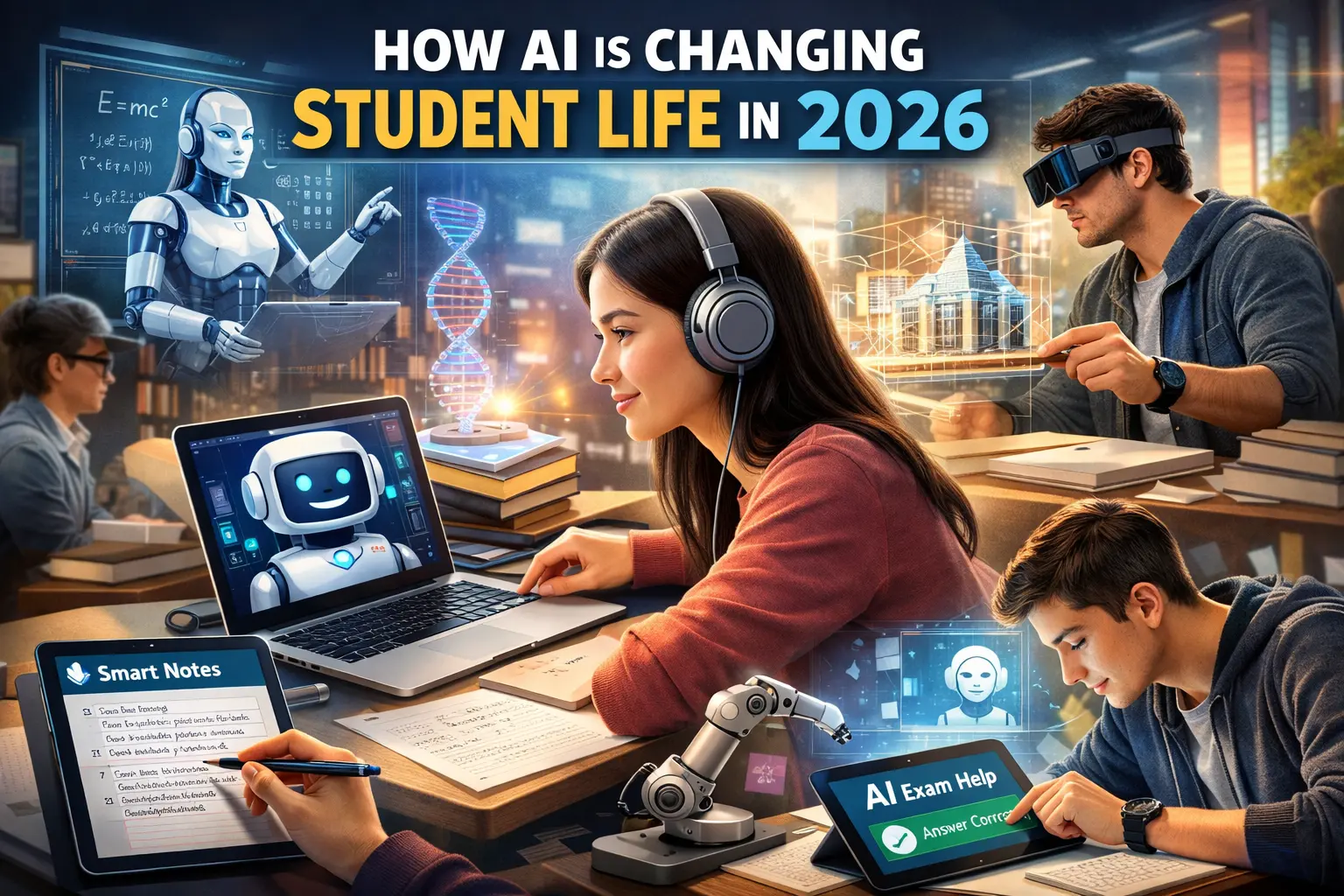
In 2026, AI is changing student life by acting as a study assistant, note organizer, practice tutor, and project helper.
Students now use AI to:
- summarize chapters
- generate practice questions
- explain difficult concepts
- structure assignments
- improve presentations
It does not replace learning.
But it changes how fast and how efficiently students learn.
Why this matters for real students
Student life has always been stressful.
Heavy syllabus.
Tight deadlines.
Competitive exams.
Group projects.
AI reduces some of that pressure.
It does not remove exams.
It does not remove effort.
But it removes friction — especially when starting or revising.
For many students, the biggest benefit is clarity and speed.
Who should care about this
School students
AI helps simplify complex chapters.
College students
It supports research, presentations, and structured notes.
Competitive exam aspirants
AI helps generate practice questions and revision summaries.
Working students
Time-saving tools matter even more.
What problem this actually solves
The real challenge is not intelligence.
It is:
- time management
- information overload
- confusion while revising
Students often struggle to begin studying because they don’t know where to start.
AI reduces that “starting difficulty.”
Instead of reading 30 pages blindly, you get a structured summary first.
Then you study deeper.
Deep explanation in simple words
Imagine you are preparing for an exam.
Earlier method:
Read full chapter → underline → write notes → revise.
Now:
Upload or paste content → get summary → ask doubts → create practice questions → test yourself.
AI compresses steps.
But remember:
If you skip understanding and only read summaries, your foundation becomes weak.
AI supports effort. It cannot replace it.
AI in Study & Learning
Concept explanation
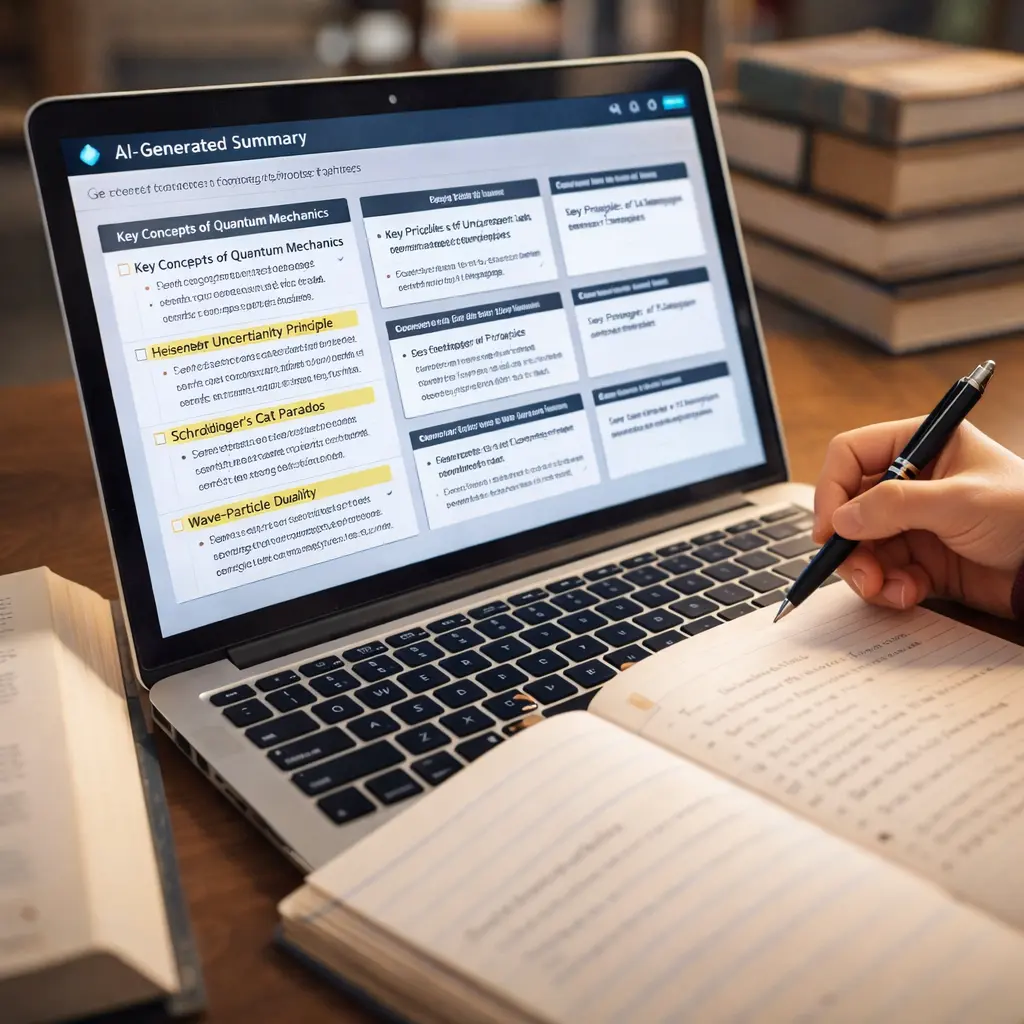
Tools like ChatGPT can explain topics in simple language.
You can ask:
- “Explain in easy terms.”
- “Give real-life example.”
- “Explain like I am 10.”
This helps when textbooks feel complicated.
Faster research
Perplexity provides summarized answers with sources.
Instead of opening 15 tabs, students read one structured explanation.
This saves time.
But students must verify important facts.
AI in Note Making
Students now:
- paste lecture notes
- convert long chapters into bullet points
- generate flashcards
- create quick revision sheets
This makes last-minute revision easier.
However, writing notes manually still improves memory.
AI notes should complement, not replace, active learning.
AI in Exam Preparation
AI helps with:
- mock tests
- MCQ generation
- answer structuring
- time-bound practice
For competitive exams, AI can simulate test patterns.
But it cannot predict exact exam questions.
The risk:
Over-dependence can reduce independent thinking.
AI in Projects & Assignments
AI assists in:
- structuring reports
- improving grammar
- creating slide outlines
- suggesting visuals
This reduces formatting stress.
But copying directly without understanding leads to weak viva performance.
Teachers increasingly detect AI-written assignments.
Students must personalize work.
Where AI does NOT help
AI cannot:
- sit in exams for you
- replace conceptual clarity
- guarantee marks
- replace discipline
Students who rely only on AI summaries may struggle in descriptive exams.
Understanding still matters.
Cost, effort, and skill expectation

Cost
Many AI tools offer free versions.
Premium features cost extra.
Effort
Students must learn how to ask clear questions.
Skill
Basic digital literacy is enough.
The biggest skill is judgment — knowing when to use and when not to.
Comparison with traditional methods
| Method | Speed | Depth | Effort |
|---|---|---|---|
| Traditional study | Slow | High | High |
| AI-assisted study | Fast | Medium–High (if used properly) | Moderate |
| AI-only summary reading | Very Fast | Low | Low |
The best results come from combining traditional study with AI assistance.
Decision guide for students
Use AI if:
- You are stuck understanding something.
- You need quick revision summaries.
- You want structured answers.
Avoid using AI if:
- You haven’t read the chapter at all.
- You plan to copy assignments blindly.
- You want shortcuts instead of learning.
Future outlook
AI tools will likely become common in classrooms.
Schools may:
- integrate AI study assistants
- redesign exams
- focus more on critical thinking
Students who learn to use AI responsibly will benefit.
Those who misuse it may struggle when independent thinking is required.
Final beginner takeaway
AI is a powerful study assistant.
But it works best when:
You read → understand → ask AI → refine → practice.
Think of AI as a tutor, not a replacement brain.
Students who use it wisely save time and reduce stress — without harming learning.
FAQ
Q1. Is it safe for students to use AI?
Yes, if used for understanding and not cheating.
Q2. Can AI help improve marks?
It can improve preparation efficiency, not guarantee marks.
Q3. Do teachers detect AI-written assignments?
Many institutions are developing detection systems.
Q4. Is AI allowed in exams?
No, unless specifically permitted.
Q5. Can AI explain complex topics better than textbooks?
Sometimes it simplifies language effectively.
Q6. Will AI make students lazy?
Only if misused.
Q7. Should school students use AI?
With guidance and supervision.
Q8. What is the best way to use AI for exams?
Use it for revision summaries and practice questions.