
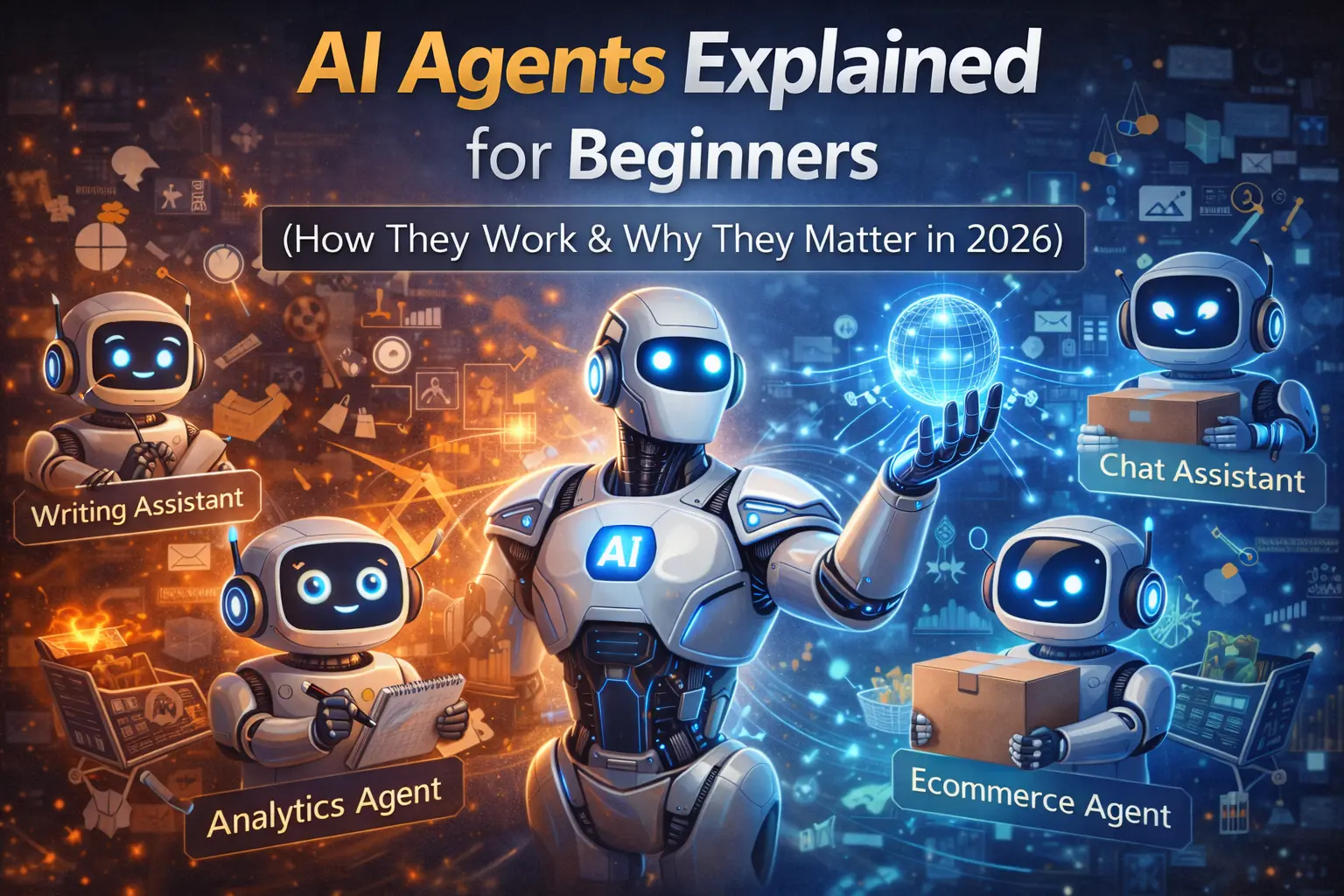
I first heard about AI agents in late 2024, and honestly, I thought it was just another tech buzzword that would fade. The term sounded vague — like someone took “AI” and added “agent” to make it sound more important. But then I actually used one. I asked an AI agent to research my competitors, and instead of just giving me a summary, it went out and searched for their recent funding rounds, pulled their latest product launches, analyzed their pricing strategies, cross-referenced industry reports, wrote a detailed brief, and sent it to my email. All while I was asleep.ai agents explained for beginners
That’s when I realized this wasn’t hype. This was a fundamental shift in how AI works.
Most people still think of AI as something that answers questions — you ask ChatGPT a question, it gives you an answer, and that’s it. AI agents are different. They don’t just respond to prompts. They take action, make decisions, use tools, and complete entire workflows on your behalf. And in 2026, they’re no longer experimental. They’re real, they’re accessible, and they’re quietly changing how work gets done.
This article exists because I think most explanations of AI agents are either too technical or too vague. I want to explain what they actually are, how they work in simple terms, and why you should care — even if you’re not technical.
Why This Topic Actually Matters
AI agents represent the next phase of AI adoption. Not the next decade — the next phase happening right now.
For the past two years, AI has been about generation — generating text, images, code, summaries. That’s useful, but it’s reactive. You give AI a prompt, it gives you output, and then you have to do something with that output.
AI agents flip that relationship. Instead of you prompting AI to do each step of a task, you tell the agent what you want to achieve, and it figures out the steps, uses the tools it needs, and completes the task autonomously. You’re managing outcomes, not micromanaging prompts.
This matters because it changes what’s possible for individuals and small teams. Tasks that used to require hiring someone or spending hours manually coordinating systems can now be delegated to an agent. Market research, customer support triage, data analysis, scheduling across time zones, monitoring systems for issues — these aren’t futuristic scenarios. They’re happening right now on platforms that non-technical people can use.
The reason this feels sudden is because 2025 was the year when AI agent platforms became genuinely usable. Before that, building an agent required programming knowledge and custom infrastructure. Now, no-code platforms let you create functioning agents in under an hour. That accessibility is what makes this shift real.
Who Should Care About This
If you’re a freelancer or small business owner handling too many things at once and wondering if there’s a way to automate the repetitive parts without hiring someone — this matters to you.
If you’re a student or professional trying to stay relevant in a job market where AI literacy is becoming a requirement — this matters to you.
If you’re someone who manages projects, coordinates teams, or handles operations and feels like you’re constantly firefighting instead of strategizing — this matters to you.
You don’t need to be technical. You don’t need to code. You need to understand what agents are capable of so you can recognize opportunities to use them. That’s the skill that separates people who leverage AI from people who watch others do it.
What Most Explanations Get Wrong
Most articles on AI agents fall into two categories.
The first category treats agents like they’re magic. “Just tell the AI what you want and it does everything!” That’s misleading. Agents are powerful, but they’re not perfect. They make mistakes, they need supervision, and they work best when you give them clear, bounded tasks. If you expect an agent to run your entire business unsupervised, you’ll be disappointed.
The second category gets too technical too fast. They talk about “multi-agent systems,” “reinforcement learning,” “tool-calling APIs,” and “autonomous workflows” without explaining what any of that actually means in practice. That scares away non-technical people who could actually benefit from using agents.
The truth is simpler than both extremes. An AI agent is software that can break down a goal into steps, use tools to complete those steps, check if things went right, and adjust if they didn’t — all without you having to tell it every single thing to do. It’s less like giving commands to a chatbot and more like delegating a project to a smart assistant who knows how to figure things out.
The other thing most guides miss: the difference between a chatbot and an agent. A chatbot waits for you to ask it something, then it responds. An agent is given a goal and actively works toward it — searching databases, calling APIs, interacting with software, making decisions based on context. That’s the key difference.
Deep Explanation: What AI Agents Actually Are and How They Work
Here’s the simplest way to understand it.
Traditional AI — like ChatGPT when you use it in the basic chat interface — is reactive. You give it a prompt, it processes that prompt, generates a response, and stops. If you want it to do something else, you have to give it another prompt. It doesn’t take action beyond generating text.
An AI agent is proactive. You tell it what you want to achieve, and it breaks that goal into a series of steps, executes those steps using whatever tools it needs, checks the results, and adjusts its approach if something didn’t work. It doesn’t stop after one response. It keeps working until the task is done.
Here’s a concrete example to make this clearer.
Let’s say you want to research competitors in your industry and create a summary report.
With traditional AI (like ChatGPT):
- You ask: “Tell me about my competitors.”
- It gives you a response based on what it already knows from its training data.
- If you want more recent information, you have to manually search for it, paste it into the chat, and ask it to analyze.
- If you want the summary formatted as a document, you have to copy-paste it into Google Docs yourself.
- Every step requires your input.
With an AI agent:
- You tell it: “Research my top 5 competitors, find their recent product launches and funding rounds, analyze their positioning, and create a summary report.”
- The agent searches the web for each competitor’s website, press releases, and news coverage.
- It pulls funding data from databases like Crunchbase.
- It analyzes their messaging and pricing strategies.
- It writes a structured report summarizing everything.
- It saves the report to your Google Drive and sends you an email notification.
- All of this happens autonomously while you’re doing something else.
That’s the difference. The agent isn’t waiting for you to micromanage every step. It’s executing a workflow on your behalf.
How does it actually work under the hood?
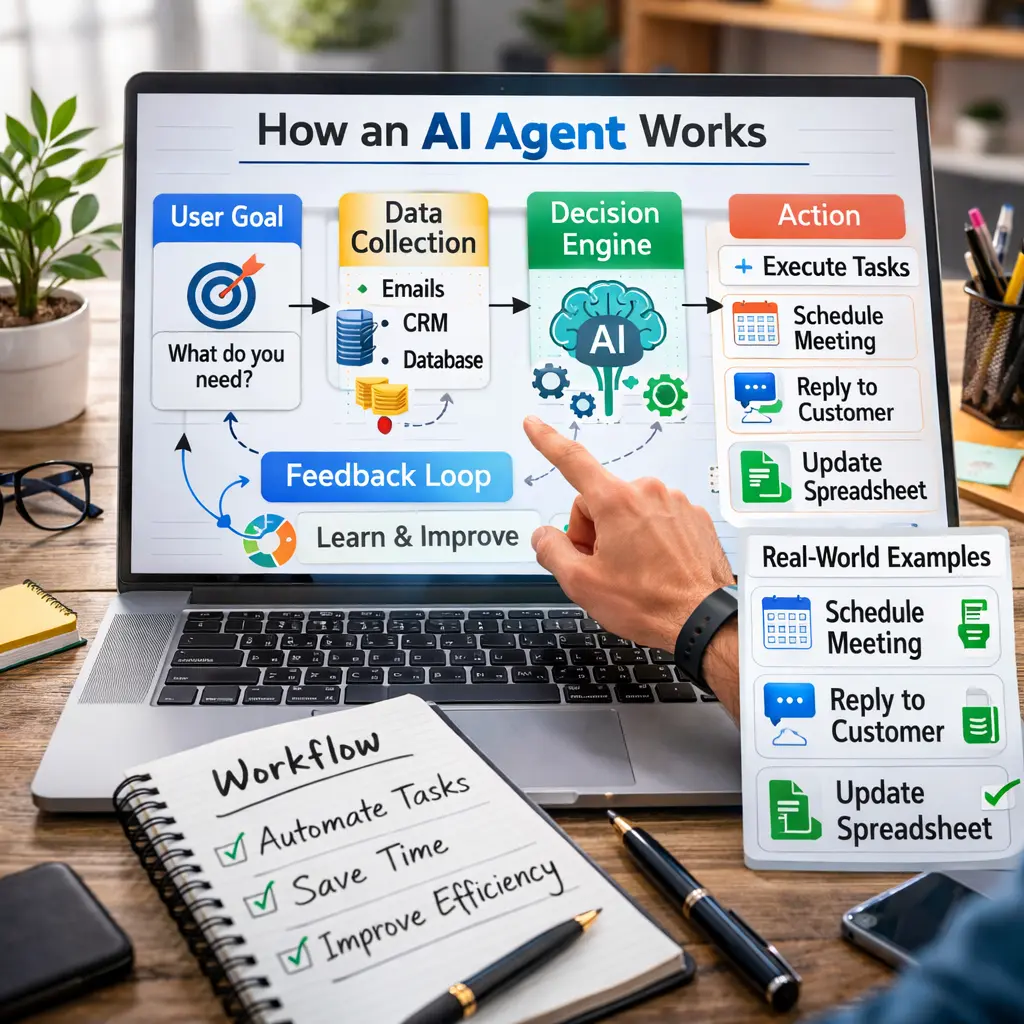
AI agents have three core capabilities that traditional AI doesn’t:
1. Tool use — The agent can call external tools like web browsers, databases, APIs, file systems, and software applications. When it needs information that isn’t in its training data, it can search for it. When it needs to save a file, it can write to your cloud storage. When it needs to send an email, it can connect to your email system.
2. Multi-step reasoning — The agent doesn’t just respond to a single prompt. It breaks your goal into smaller sub-tasks, completes each one in sequence, and uses the output from one step as the input for the next. If something goes wrong in step 3, it can adjust its approach for step 4.
3. Feedback loops — After completing each step, the agent checks whether that step succeeded. If the search returned no results, it tries a different search query. If the API call failed, it retries. If the data doesn’t match the expected format, it reformats it. This self-correction is what makes agents autonomous.
All of this is happening in real-time using advanced language models like GPT-4, Claude, or Gemini as the “brain” of the agent. The model decides what to do next, and the agent infrastructure (the platform or code managing the agent) handles the execution.
In 2026, the big development is that these capabilities are no longer locked behind technical barriers. Platforms like AutoGPT, LangChain, Agent Factory, Lindy, and others provide user interfaces where non-technical people can create agents without writing code.
Real-World Implications
The practical impact of AI agents is already visible across industries.
In customer service, agents are handling tier-1 support inquiries end-to-end — reading customer emails, pulling account data from CRM systems, identifying the issue, drafting responses, and only escalating to humans when the problem is complex. Some companies report 40-60% reduction in support ticket volume because agents resolve issues before they ever reach a human.
In sales and marketing, agents are researching prospects, personalizing outreach emails, scheduling meetings, tracking follow-ups, and even generating sales materials. A marketing manager who used to spend 10 hours a week on competitive research now delegates that to an agent and reviews the output in 30 minutes.
In software development, agents are writing code, running tests, identifying bugs, and submitting pull requests for human review. Developers are using agents as junior assistants who handle repetitive tasks while the human focuses on architecture and complex logic.
In operations, agents are monitoring systems for anomalies, flagging issues before they become critical, updating dashboards, and generating automated reports. This proactive monitoring means problems are caught earlier and resolved faster.
The time savings are measurable. Tasks that used to take hours now take minutes. But the bigger shift is strategic. When repetitive tasks are automated, people have more time for high-value work — decision-making, creativity, relationship-building, strategy. That’s the real impact.
Types of AI Agents (Simple Breakdown)
Not all AI agents are the same. Here’s a simple way to categorize them:
Simple Reactive Agents These agents respond to current inputs based on predefined rules. Example: A fraud detection agent that flags transactions matching certain patterns. It doesn’t learn or adapt — it follows a script.
Goal-Based Agents These agents work toward a specific objective and plan their actions to achieve that goal. Example: An agent tasked with booking the cheapest flight for a given route — it searches multiple sites, compares options, and books the best deal.
Learning Agents These agents improve over time by analyzing past actions and outcomes. Example: A customer support agent that gets better at understanding common issues the more tickets it handles.
Multi-Agent Systems Multiple agents working together, each with a specialized role. Example: One agent handles research, another drafts content, a third schedules posts — they coordinate to manage a full marketing workflow.
For beginners, most use cases involve goal-based agents. You give them a task, they figure out how to complete it, and they deliver the result.
Comparison: AI Agents vs Traditional AI vs Automation Tools
| Feature | Traditional AI (ChatGPT) | Automation Tools (Zapier) | AI Agents |
|---|---|---|---|
| Autonomous? | No — waits for prompts | No — follows fixed workflows | Yes — plans and adjusts |
| Handles multi-step tasks? | Only with repeated prompts | Yes, if pre-configured | Yes, dynamically |
| Uses external tools? | Limited | Yes, via integrations | Yes, intelligently |
| Adapts to changes? | No | No | Yes |
| Requires coding? | No | No | No (with no-code platforms) |
The table shows the differences clearly. Traditional AI is reactive. Automation tools are rigid. AI agents are adaptive.
If you need something to answer questions — use traditional AI. If you need to connect two apps and trigger actions based on simple rules — use automation tools. If you need something to figure out how to achieve a goal and handle complexity autonomously — use an AI agent.
Key Facts About AI Agents
The global AI agent market is projected to reach $50.31 billion by 2030, reflecting rapid adoption across industries.
In 2026, less than 5% of tools marketed as “AI agents” are actually autonomous. Most are just chatbots with better branding. Look for tools that can use external tools and execute multi-step workflows.
AI agents can reduce operational costs by 30-50% in tasks involving data retrieval, report generation, and customer support triage.
Current AI agents still require human oversight. They can handle repetitive tasks autonomously, but humans need to review decisions, especially in high-stakes scenarios.
The biggest technical challenge for AI agents in 2026 is context management. When agents interact with many tools simultaneously, managing the data they access and ensuring they don’t exceed system limits is complex.
Expert Perspective: The Balanced View
AI agents are powerful, but they’re not a replacement for human judgment.
The mistake many people make is treating agents like fully autonomous employees. They’re not. They’re more like smart interns — capable of handling defined tasks, but they need supervision, clear instructions, and quality checks.
The areas where agents excel: repetitive tasks, data aggregation, research, scheduling, monitoring, and anything that follows a logical workflow. They’re fast, they don’t get tired, and they can work 24/7.
The areas where agents struggle: ambiguous situations, tasks requiring deep creativity, ethical decisions, and anything where context matters more than logic. If the task requires reading between the lines or understanding subtle human dynamics, agents will miss nuances.
Privacy and security are also legitimate concerns. When you give an agent access to your email, CRM, or internal systems, you’re trusting that the platform handling the agent is secure. Choose platforms with strong data governance and read their privacy policies.
The responsible approach is to start small. Delegate low-risk tasks to agents first — things like organizing files, summarizing documents, or scheduling meetings. As you gain confidence, gradually expand what you delegate. But always review critical outputs before acting on them.
Future Outlook: What’s Coming in the Next 3 to 5 Years

AI agents will become more reliable and easier to integrate. Right now, setting up an agent to work across multiple systems requires some technical knowledge. By 2028, it will be as simple as connecting apps on your phone.
The biggest shift will be multi-agent collaboration. Instead of one agent handling everything, you’ll have specialized agents working together — a research agent, a writing agent, a scheduling agent — coordinated by a “supervisor” agent that manages the workflow.
We’ll also see agents embedded directly into business software. Your CRM, project management tool, and email platform will have built-in agents that understand your workflows and proactively suggest or complete tasks.
The long-term vision is that AI agents become invisible infrastructure. You won’t “use an AI agent” the same way you don’t “use the internet.” You’ll just delegate tasks to your systems, and agents will handle the execution in the background.
For individuals, this means the barrier between having an idea and implementing it will shrink dramatically. You won’t need to hire a team or learn ten different tools. You’ll describe what you want, and your agents will figure out how to make it happen.
The people who benefit most will be those who learn to work with agents effectively — defining goals clearly, understanding what agents can and can’t do, and reviewing outputs critically.
Final Takeaway for Beginners
You don’t need to build an AI agent from scratch. You don’t need to code. You just need to understand what they are and start experimenting.
Pick one task you do repeatedly — something that feels tedious and takes time. That’s your starting point.
Use a no-code agent platform like Lindy, Agent Factory, or AutoGPT, and try delegating that task. Give the agent clear instructions. Review the output. Adjust and try again.
The first time you use an agent, it might feel clunky. But once you see a task complete itself while you’re doing something else, the shift becomes real. That’s when you understand why this matters.
AI agents aren’t the future. They’re the present. The question is whether you’re paying attention.
Frequently Asked Questions
1.What is an AI agent in simple terms?
An AI agent is software that can understand a goal, break it into steps, use tools to complete those steps, and adjust its approach if something doesn’t work — all without needing step-by-step instructions from you.
2.How is an AI agent different from ChatGPT?
ChatGPT responds to prompts and generates text. An AI agent can take action — search the web, call APIs, write files, send emails, interact with software, and execute multi-step workflows autonomously.
3.Do I need coding skills to use AI agents?
No. In 2026, many platforms offer no-code interfaces where you can create and deploy AI agents using visual tools and plain language instructions.
4.Are AI agents safe to use?
AI agents are generally safe if you use reputable platforms with strong security and data governance. Start by delegating low-risk tasks and gradually expand as you gain confidence. Always review outputs before acting on them.
5.What tasks are AI agents best at?
AI agents excel at repetitive, logical tasks like research, data aggregation, scheduling, monitoring systems, customer support triage, report generation, and coordinating workflows across multiple tools.
6.Can AI agents replace jobs?
AI agents will change how some jobs are done, especially tasks involving repetitive workflows. But they work best as assistants, not replacements. Humans still provide judgment, creativity, and oversight.
7.How much do AI agents cost?
Many platforms offer free tiers for basic use. Paid plans typically range from $20 to $200 per month depending on features, usage limits, and integrations. Enterprise solutions cost more.
What’s the biggest risk with AI agents?
The biggest risk is over-reliance without oversight. Agents can make mistakes, especially in ambiguous situations. Always review critical outputs and maintain human oversight for high-stakes decisions.