I remember sitting in my college room, opening tab after tab, searching for ways to earn something on the side. Every article I found either told me to “start a YouTube channel” or listed 50 apps that paid ₹2 per survey. Nothing was actually useful. Nothing was honest.best AI tools for students to earn money
That frustration is part of why VYTORI exists — because real information, explained simply, is genuinely hard to find. So this guide is written the way I wish someone had written it for me back then.
Why This Topic Actually Matters Right Now
This is not a “10 ways to make money online” article. Those are everywhere and most of them are useless.
What’s actually changed in the last two years is this — AI tools have created a genuine skill gap. Students who know how to use even two or three of these tools can now deliver work in 2 hours that used to take a professional a full day. That gap is real money, and it’s available right now to anyone willing to spend a few weeks learning properly.
The other thing that matters specifically for students is time. You don’t have 40 free hours a week. You have maybe 8 to 12, and you need to make those count. These tools, when used correctly, let you do exactly that.
Who Should Actually Read This
If you’re a college student, a postgrad, or even someone in their final school years who wants real income without dropping studies — this is written for you.
You don’t need a coding background. You don’t need a design degree. What you need is a laptop, decent internet, and the patience to actually learn these tools instead of opening them once, getting confused, and giving up. That’s the honest requirement.
This is also for students who tried freelancing before and couldn’t compete with experienced professionals. AI changes that equation. Not completely, not magically — but meaningfully.
What Most Guides Get Wrong
The frustrating thing about most content on this topic is that it lists tool names without connecting them to actual income. “Use ChatGPT to write content!” — okay, but write content for whom? Sell it where? At what price?
A few specific problems I see repeatedly:
Every article treats all AI tools as equally useful for everyone. They’re not. A student who’s decent at writing has a completely different starting point than someone with a design eye or a technical interest. The tool should match the person.
Most guides also completely skip the platform question. Knowing which AI tool to use is only half the answer. Where you sell the output — Fiverr, Upwork, local businesses, Instagram pages — matters just as much, and no one talks about it.
And almost every list includes tools that either cost too much for a student or require months of skill-building before you see a single rupee. That’s not helpful. That’s just content for content’s sake.
The Actual Breakdown — Simple and Honest
Think of these tools in three categories: tools that help you create faster, tools that help you think and research better, and tools that help you automate tasks that used to need a whole team.
Creating Faster
ChatGPT and Claude are the obvious starting points. But just using them to write generic blog posts is the wrong move in 2025 — that market is already flooded. The smarter use is offering specific services to specific people.
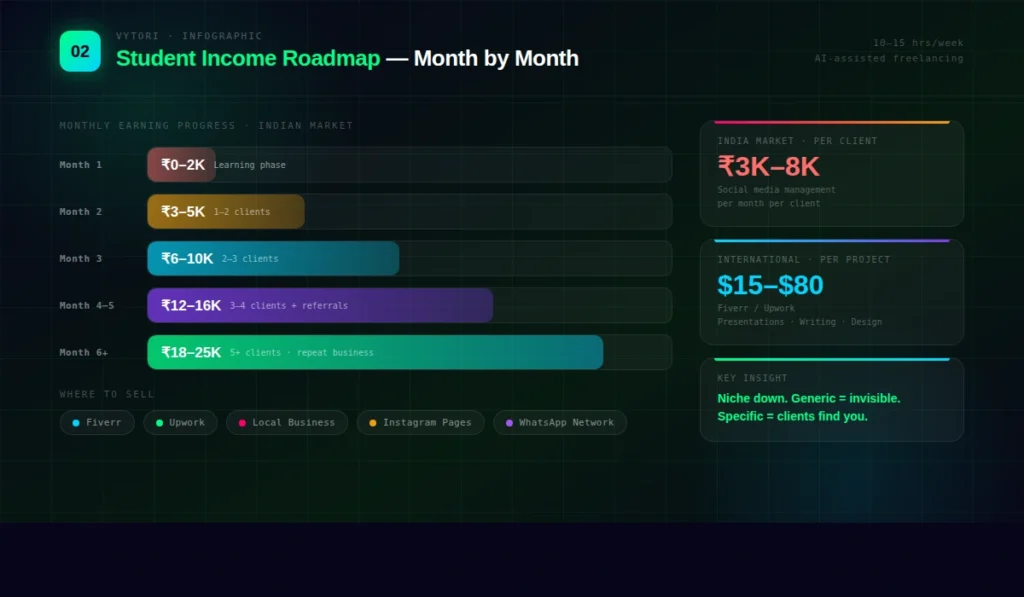
Think about it this way — a local coaching center, a small restaurant, a boutique, a fitness trainer running an Instagram page. These people need captions, short posts, email newsletters, WhatsApp broadcast messages. They have no time to write them and no budget to hire a full-time person. A student who shows up with clean, decent content consistently can charge ₹3,000 to ₹8,000 a month per client. That’s real money for real work.
Canva’s AI features deserve more attention than they get. Canva has built AI-assisted design into its platform to the point where someone with zero design background can produce social media graphics, basic brand kits, and simple presentations that look genuinely decent. Combine ChatGPT for copy and Canva for design and you have what is essentially a mini creative agency — as one person, as a student.
Thinking and Researching Better
Google’s NotebookLM is one of the most underrated free tools available right now. You upload PDFs or documents, and it helps you analyze, summarize, and ask questions about that content. For a student, this opens up services like research summarization, study guide creation, or helping professionals prepare for certifications and exams by condensing lengthy materials.
This isn’t about selling AI output directly. It’s about using AI to let you take on work you couldn’t handle alone before.
Automating What Used to Need a Team
Gamma.app creates structured, visually reasonable presentations from text in minutes. Presentation creation is a massively underserved market — students, startup founders, and professionals constantly need pitch decks and explainer decks but either can’t design them or simply don’t have the time. A student offering “AI-assisted presentation design” on Fiverr, with a few solid samples, can charge anywhere from $15 to $80 per project.
InVideo AI is worth mentioning for Indian students specifically. It creates short videos from scripts or text prompts. Small YouTube channels, local business owners, educational creators — there’s real demand here from people who want video content but can’t afford video editors. If you can write a decent script and guide the tool, you have a sellable service.
What This Actually Looks Like in Practice- Best AI tools for students to earn money
Let’s talk real numbers because vague potential doesn’t pay for anything.
A student in a tier-2 city offering social media captions using ChatGPT, basic graphics using Canva AI, and simple presentations using Gamma — targeting 3 to 5 local clients — can realistically earn between ₹8,000 and ₹20,000 a month working 10 to 15 hours a week. That’s not life-changing money. But it covers expenses, builds a portfolio, and compounds into something bigger over time.
For students targeting international clients on Fiverr or Upwork, the numbers are better but competition is higher. The trick is specificity. “I offer AI writing services” gets lost. “I write product descriptions for Shopify stores, delivered in 24 hours” gets found. Niche services attract real buyers.
The longer-term implication is something most students don’t think about — portfolio building. If you start doing AI-assisted freelance work at 19 or 20, by graduation you have actual client work, real testimonials, and proven output. In a job market that increasingly wants proof of work over degrees alone, that matters more than most people realize right now.
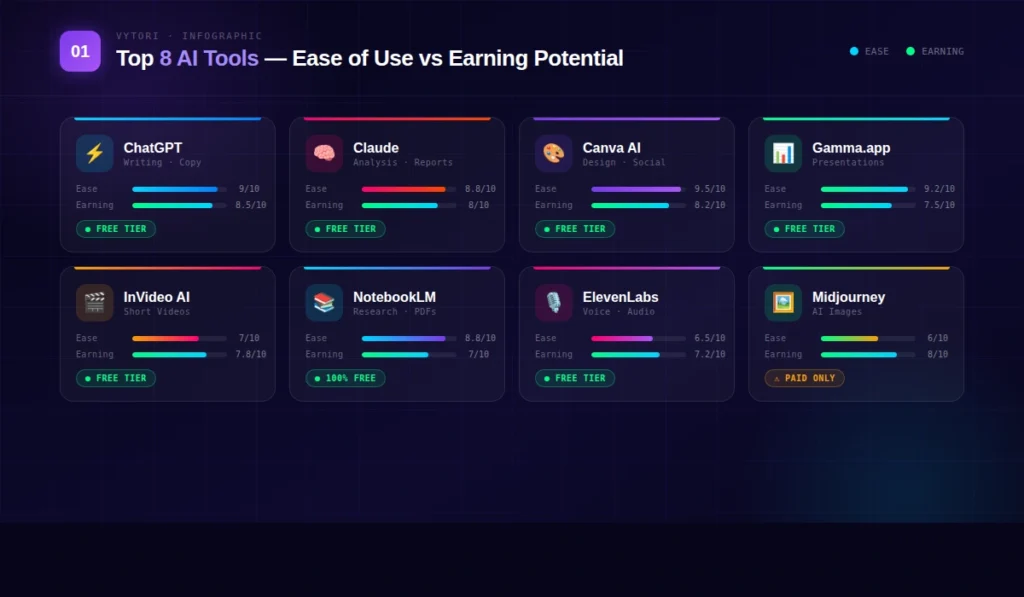
Tool Comparison — What’s Actually Worth Your Time
| Tool | Best For | Free Plan | Learning Curve | Earning Path |
|---|---|---|---|---|
| ChatGPT | Writing, copy, research | Yes | Low | Content writing, ghostwriting |
| Claude | Long-form writing, analysis | Yes | Low | Research summaries, reports |
| Canva AI | Design, social graphics | Yes | Very Low | Social media management |
| Gamma.app | Presentations | Yes (limited) | Low | Pitch deck design |
| InVideo AI | Short video creation | Yes (watermark) | Medium | YouTube shorts, reels |
| NotebookLM | PDF analysis, research | Yes | Low | Research services, study guides |
| ElevenLabs | Voice generation | Yes (limited) | Medium | Podcast intros, explainer audio |
| Midjourney | Image generation | No | Medium | Illustrations, thumbnails |
One thing the table doesn’t show — Midjourney produces beautiful images but requires a paid subscription and real practice before you can sell confidently. For a student starting with close to zero budget, tools with solid free tiers like ChatGPT, Canva, Gamma, and NotebookLM are where to begin. Upgrade only when client income justifies it.
Fiverr added a dedicated “AI Services” category in 2023 — which means the platform itself has formally recognized AI-assisted work as a legitimate freelance vertical. That’s not nothing.
A Few Key Facts Worth Knowing
Canva has over 200 million monthly active users globally, with a growing portion using AI features specifically for content creation work.
Gamma.app is used by over 20 million people and remains free for basic use — meaning the entry barrier is genuinely zero.
NotebookLM is made by Google, is completely free, and handles surprisingly complex research tasks. It’s one of the most underused tools in this space.
The Honest Take — Not Just the Exciting Parts
AI tools lower the barrier to entry. That’s real. But they don’t eliminate the need for taste, judgment, or basic communication skills.
A student who uses ChatGPT to write a post without editing it or adding anything personal will produce output that any experienced client immediately recognizes as generic. That doesn’t convert into repeat business or referrals.
The students actually making consistent money from these tools are treating AI as an assistant, not a replacement for their own thinking. They use it to draft, then they refine. They use it to ideate, then they filter. The quality gap between “AI only” and “AI plus human judgment” is still large enough that the second option commands meaningfully better prices.
There’s also a dependency risk worth naming. If your entire income depends on one tool and that tool changes its pricing or features — which happens — you’re exposed. Building transferable skills alongside tool proficiency is the smarter long-term move.
Where This Is Going in the Next 3 to 5 Years
A few things are fairly clear from where things are heading.
The raw task of generating content using AI will become increasingly commoditized. Students who are just reselling AI output with minimal added value will find it harder to compete by 2026 or 2027. The premium will go to those who combine AI with genuine domain knowledge — a medical student using AI to create health explainer content will outcompete a generalist every time.
Agentic AI — where tools can handle multi-step tasks with minimal input — is becoming more accessible. Students who understand workflow automation in the next two to three years will be able to offer businesses real operational value. That’s a higher-value skill than content writing, and the learning curve is genuinely manageable.
The Indian freelance market for AI services is still early. Most of the conversation around AI freelancing is US and Europe-focused. For students targeting Indian small businesses — which number in the hundreds of millions — the demand for affordable, AI-powered marketing and content support is large and mostly untapped right now.
What to Actually Do If You’re Starting Today
Don’t try to learn everything at once. Pick one income path — social media content, presentations, research services, or short-form video — and pick the one or two tools that support that path specifically.
Get one client, even if they pay very little. Learn what they actually need. Deliver something that makes them want to come back. That’s the entire playbook at the start.
The biggest mistake I see beginners make is spending weeks learning tools and zero time creating samples or approaching clients. You don’t need to be an expert. You need to be good enough to be useful to someone — and with most of these tools, that threshold is reachable in two to three focused weeks.
AI won’t make you rich overnight. Anyone saying otherwise is selling something. But for a student with limited time and limited budget, these tools represent the most realistic path right now to building real, independent income — and more importantly, skills that keep compounding long after college ends.
Frequently Asked Questions FAQ
1.I have no design or writing background. Can I still use these tools to earn?
Yes, but be realistic about the starting point. Canva is the most beginner-friendly design tool on this list — most people can produce decent work within a few days. For writing, ChatGPT helps significantly, but you still need to edit and personalize the output. Client communication and understanding what someone actually needs matters more than technical tool knowledge when you’re starting out.
2.How much can I realistically earn in the first month?
Probably very little — maybe ₹2,000 to ₹5,000 targeting Indian clients, or $50 to $100 on international platforms. The first month is about landing your first client and building samples. Month two and three are when consistent income starts if you stick with it and keep improving.
3.Do I need to pay for these tools?
For starting out, no. ChatGPT’s free tier, Canva’s free plan, Gamma’s free plan, and NotebookLM are enough to build your first services and land initial clients. Upgrade only when client income justifies the cost.
4.Is selling AI-assisted content legal?
For most commercial uses, yes — but always check the specific terms of service for each tool. Most AI companies allow commercial use of outputs. When working with clients, focus on the quality and value you’re delivering. That’s what they’re paying for.
5.Won’t clients refuse to pay if they know I used AI?
This fear is more common than the reality. Most small business clients care about one thing — does the result work for them? Does the caption sound right, does the design look clean, does the presentation make sense? If the quality is there, the tool behind it is largely irrelevant to them.
6.ChatGPT or Claude — which one should I start with?
Both have free tiers worth trying. ChatGPT has a larger community of tutorials and is slightly better for general tasks. Claude tends to handle longer documents and more nuanced writing more naturally. Try both for a week and see which one fits how you think. There’s no wrong answer here.
7.Can students in smaller cities use this?
Absolutely — and in some ways it’s easier. Freelance platforms are completely location-agnostic. And if you target local businesses in your own city, you’re competing with almost nobody. Being local and available in person is actually an advantage over remote competitors.
8.What if I try and don’t get any clients?
Most people fail the first time because they offer generic services or give up too early. The fix is specific: niche down your service, create one solid sample for that specific service, and reach out to at least 15 to 20 potential clients before concluding it doesn’t work. Most people quit after 2 or 3 rejections. The ones who push through almost always find their first client.